Posts

Leaving Medicare Advantage: Can You Actually Switch Back? The Medigap Question to Answer Before You Change Coverage

Image
If you are in a Medicare Advantage plan and thinking about returning to Original Medicare, changing coverage and getting a Medigap policy are two separate questions. An enrollment opportunity does not, by itself, establish Medigap eligibility or guarantee a particular policy, so the Medigap question needs a verified answer before you commit to the change, not after. Below you will find a two-window calendar, a research sequence, a state-rule worksheet, and a decision gate to fill in with your own facts. ✅ Leaving Medicare Advantage: Can You Actually Switch Back? Th… at a glance ✓ Window Dates: What to know ✓ Medicare Open Enrollment October 15 through December 7, 2026: The plan has to receive your enrollment request by December 7. Changes made duri… ✓ Medicare Advantage Open Enrollment Period January 1 through March 31, 2027: Allows one change during that window. 1. The Exit Problem: Two Questions, Not One You want to leave Medicare Advantage and return to Original Medicare. But...
I Bonds at 4.26%: 3 Mistakes That Could Cost You by November 1

Image
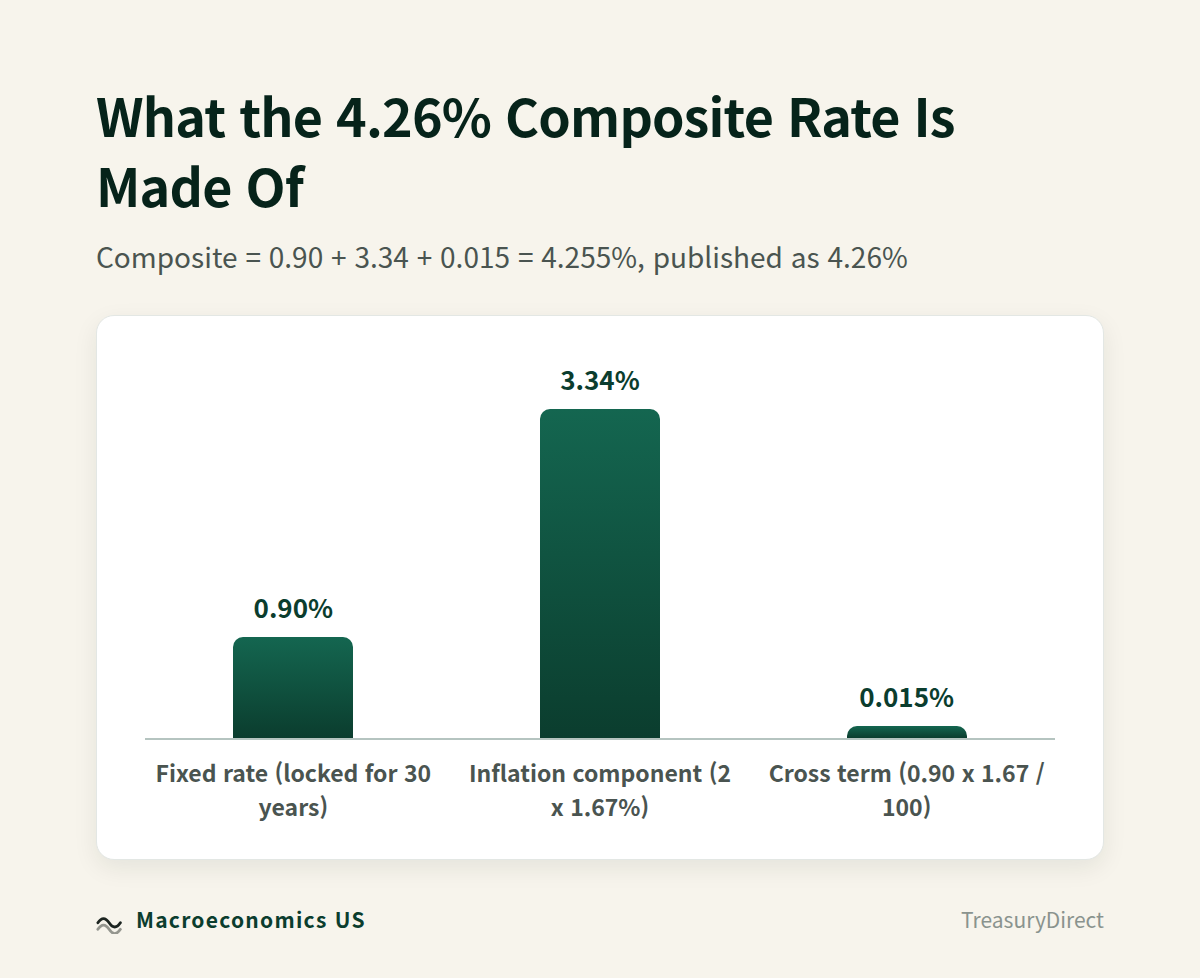
Of the 4.26% composite rate on I Bonds issued May 1 to October 31, 2026, only the 0.90% fixed rate stays with a bond for its 30-year life. If you are deciding whether to buy before the November 1 announcement, three mistakes could cost you money: buying or waiting without checking the fixed rate, locking up cash you may need within 12 months, and ignoring the five-year interest penalty. Each comes down to arithmetic you can run yourself, and the formulas are included. Composite rate on I Bonds issued May 1 to October 31, 2026 4.26% Only the 0.90% fixed rate stays locked for the bond's 30-year life. The inflation component resets every six months. Source: TreasuryDirect *Baseline: TreasuryDirect's figures for bonds issued May 1 to October 31, 2026, as of October 23, 2026. Figures tagged [ESTIMATE] are my arithmetic from those published inputs, with the formula shown. They are rule-of-thumb, not a forecast. This is general information, not tax or investment advice. Official fi...

Don't Prepay 100% of Your Tax Bill: The Safe Harbor That Could Save You From Penalties

Image
Two benchmarks set your target for avoiding an underpayment penalty: 90% of this year's tax or 100% of last year's tax, whichever is smaller. If your income jumped this year, the second number could sit well below your full bill, so prepaying 100% of this year's tax may be more than the rules ask. Whatever you do not prepay is still due when you file, and this article covers the math, the 110% exception, and a checklist for the January 15, 2027 deadline. The most the penalty rules ever ask you to prepay 90% Your target is the smaller of 90% of this year's tax or 100% of last year's tax (110% if last year's AGI topped $150,000), never 100% of this year's bill. Source: IRS Publication 505 *General information only, not personal tax advice. This article covers the safe-harbor targets and timing rules in [IRS Publication 505](https://www.irs.gov/publications/p505) and [Form 2210](https://www.irs.gov/forms-pubs/about-form-2210) as of October 23, 2026. It does ...

The $25,000 Retirement Tax Trap: Why More Social Security Can Become Taxable Without a New Law

Image
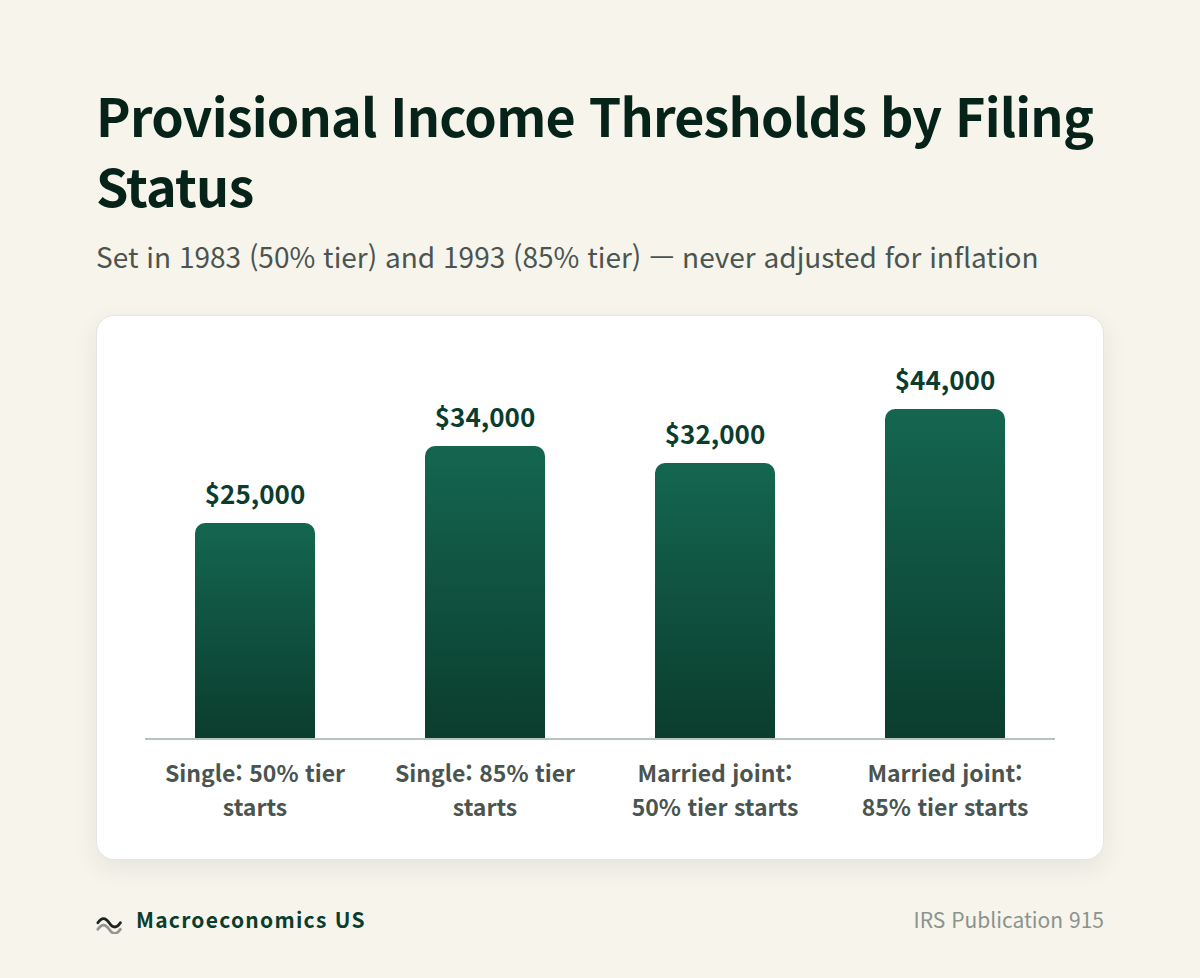
$25,000 of provisional income is the line where a single filer's Social Security benefits can start becoming taxable, and that figure has never been adjusted for inflation. Benefits rise with cost-of-living adjustments (COLAs) while the line stays fixed, so you can owe tax on more of your benefits in a year when no law changed. If you collect Social Security plus other income, such as IRA withdrawals or interest, the sections below give you the thresholds, a formula for your own numbers, and a year-end review list. The fixed line for single filers $25,000 Provisional income where Social Security benefits can start becoming taxable, set in 1983 and never adjusted for inflation, while benefits rise with COLAs. Source: IRS Publication 915 The Thresholds That Never Got an Inflation Adjustment Whether any of your benefits are taxable depends on a number called provisional income (also called combined income), which the next section breaks down. The IRS compares that number with tw...

Child Tax Credit 2026: The $2,200 Credit, the $1,700 Refundable Part, and the SSN Rule That Can Zero It Out

Image
Bottom line: For tax year 2026, the Child Tax Credit is worth up to $2,200 per qualifying child under 17 , and up to $1,700 of it is refundable through the Additional Child Tax Credit. The phase-out starts at $200,000 of income ($400,000 for joint filers). You claim it on the return you file in early 2027, using Schedule 8812. One rule catches families off guard: if the child's Social Security number was not issued before your return's due date, the credit is not delayed. It is gone for that year. The headline number rose from $2,000 to $2,200 for tax year 2025 under the One Big Beautiful Bill Act, and held at $2,200 for 2026 -- the inflation adjustment did not clear the law's $100 rounding step. It is easy to assume nothing else changed. That assumption is expensive. The One Big Beautiful Bill Act made the credit permanent and tightened the identification rules at the same time, so the families who gained the extra $200 are not always the families who assume they qualif...