I Bonds at 4.26%: 3 Mistakes That Could Cost You by November 1
Of the 4.26% composite rate on I Bonds issued May 1 to October 31, 2026, only the 0.90% fixed rate stays with a bond for its 30-year life. If you are deciding whether to buy before the November 1 announcement, three mistakes could cost you money: buying or waiting without checking the fixed rate, locking up cash you may need within 12 months, and ignoring the five-year interest penalty. Each comes down to arithmetic you can run yourself, and the formulas are included.
*Baseline: TreasuryDirect's figures for bonds issued May 1 to October 31, 2026, as of October 23, 2026. Figures tagged [ESTIMATE] are my arithmetic from those published inputs, with the formula shown. They are rule-of-thumb, not a forecast. This is general information, not tax or investment advice. Official figures: [TreasuryDirect I Bonds](https://www.treasurydirect.gov/savings-bonds/i-bonds/).*
The 4.26% Rate: What It Actually Means
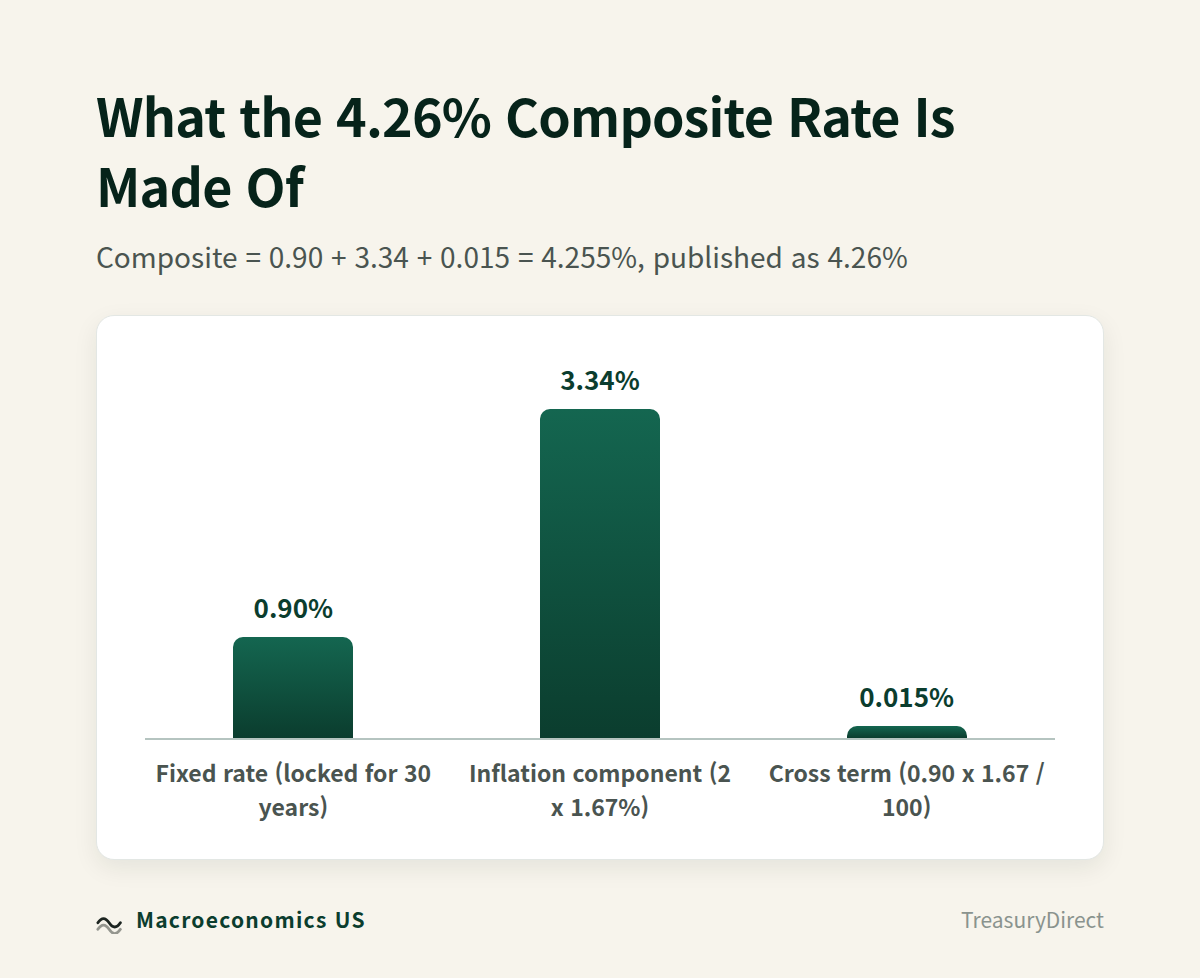
TreasuryDirect lists the composite rate for I Bonds issued May 1 to October 31, 2026 at 4.26%. That headline number is built from a fixed rate of 0.90% and an inflation component based on a semiannual inflation figure of 1.67%. The published composite formula is:
Composite = Fixed + (2 × Semiannual inflation) + (Fixed × Semiannual inflation)
My read: the 2 converts a six-month inflation figure into an annual one. Here is the build-up with today's inputs. Because the rates are entered in percent, the cross term is divided by 100.
| Piece | Formula | Result |
|---|---|---|
| Fixed rate | Published | 0.90% |
| Inflation component | 2 × 1.67 | 3.34% |
| Cross term | 0.90 × 1.67 ÷ 100 | 0.015% |
| Sum | 0.90 + 3.34 + 0.015 | 4.255%, which rounds to the published 4.26% |
[ESTIMATE: each line is arithmetic from the published inputs, formulas shown.]
Percent math and dollar math tell the story differently. In percent terms, about 78% of the 4.26% comes from the inflation component and about 21% from the fixed rate [ESTIMATE: 3.34 ÷ 4.255 ≈ 78%; 0.90 ÷ 4.255 ≈ 21%]. In dollars on a $10,000 purchase, that is roughly $90 a year from the fixed rate, $334 from the inflation component and $1.50 from the cross term, about $426 in total [ESTIMATE: $10,000 × 0.90% = $90; $10,000 × 3.34% = $334; $10,000 × 0.015% = $1.50; total $10,000 × 4.26% = $426].
Think of it as base pay plus a bonus that is recalculated twice a year. The fixed rate is the base pay and stays put for the bond's 30-year life. The composite resets every six months from the month you bought. My read: that reset works through the inflation component, because the fixed rate is locked. The 0.90% is the only part of the 4.26% you can lock in.
What Changes on November 1 — and What Doesn't
New fixed and composite rates are announced every May 1 and November 1, and the window for today's rates closes October 31. My read: bonds issued on or after November 1 are the ones priced off the new announcement.
| Item | Changes on November 1? | Detail |
|---|---|---|
| Fixed rate on a bond you own | No | Set at purchase and unchanged for the bond's 30-year life |
| Rates offered on new bonds | Yes, a new announcement | Announced every May 1 and November 1 |
| Composite rate on a bond you own | On its own schedule | Resets every 6 months from that bond's issue month |
For a bond bought in October 2026, the six-month clock runs from October, so its first reset falls six months after its issue month. The other rules in this article (the 12-month lock, the 5-year forfeiture and the $10,000 limit) are TreasuryDirect's terms as of October 23, 2026. Recheck them after the announcement.
Here is the chain from announcement to wallet, with a number at each step:
- Event: new fixed and composite rates are announced November 1. Baseline to compare: 0.90% fixed, 4.26% composite.
- Transmission: a bond you buy keeps its fixed rate for life while its composite resets every 6 months. Per percentage point, the fixed rate moves your composite about one-for-one, and the semiannual inflation figure moves it about two-for-one [ESTIMATE: from the composite formula, a 0.10-point change in the fixed rate shifts the composite by about 0.10 point; a 0.10-point change in semiannual inflation shifts it by about 2 × 0.10 = 0.20 point].
- Wallet: on $10,000, 0.10 point of fixed rate is about $10 a year, and 0.10 point of semiannual inflation is about $20 a year until the next reset [ESTIMATE: $10,000 × 0.10% = $10; $10,000 × 0.20% = $20].
The trade-off in plain terms: the inflation figure pulls twice as hard per point but resets, while the fixed rate pulls half as hard and stays.
Mistake 1: Buying or Waiting Without Checking the Fixed Rate
The mistake is treating 4.26% as the number to buy at or wait for. It is a blend, and a headline composite can move for reasons unrelated to the part you keep.
Because the composite includes the inflation component, a higher composite on November 1 could come from higher semiannual inflation alone, with no gain in the fixed rate. A lower composite could even arrive alongside a higher fixed rate. My read: the new fixed rate is the first number to check, because it is the one that stays with a bond you buy.
Two versions of this mistake show up:
- Buying because 4.26% looks high. Only the 0.90% fixed portion is permanent. The composite resets every six months from your issue month, so 4.26% is a snapshot, not a 30-year rate.
- Waiting because the composite might rise. If the new fixed rate comes in below 0.90%, waiting could leave you with a permanently lower fixed rate on the bonds you buy. If it comes in above, waiting could have helped. Neither outcome is known today.
Reader math: Yearly dollar gap ≈ Amount × (New fixed rate - 0.90%), with rates written as decimals. Each 0.10 point is about $10 a year on $10,000, or about $50 over five years [ESTIMATE: $10,000 × 0.10% = $10; $10 × 5 = $50; ignores compounding and assumes you hold the full five years].
The fix: decide in advance what you will do if the new fixed rate comes in above, at, or below 0.90%. If you cannot write down all three responses, you are guessing, and the split purchase in the checklist below could suit you better. Also note that purchases before and after November 1 within 2026 share the same $10,000 per-person, per-calendar-year limit on electronic I Bonds, so waiting does not create extra room this year.
Mistake 2: Locking Up Money You May Need Within 12 Months
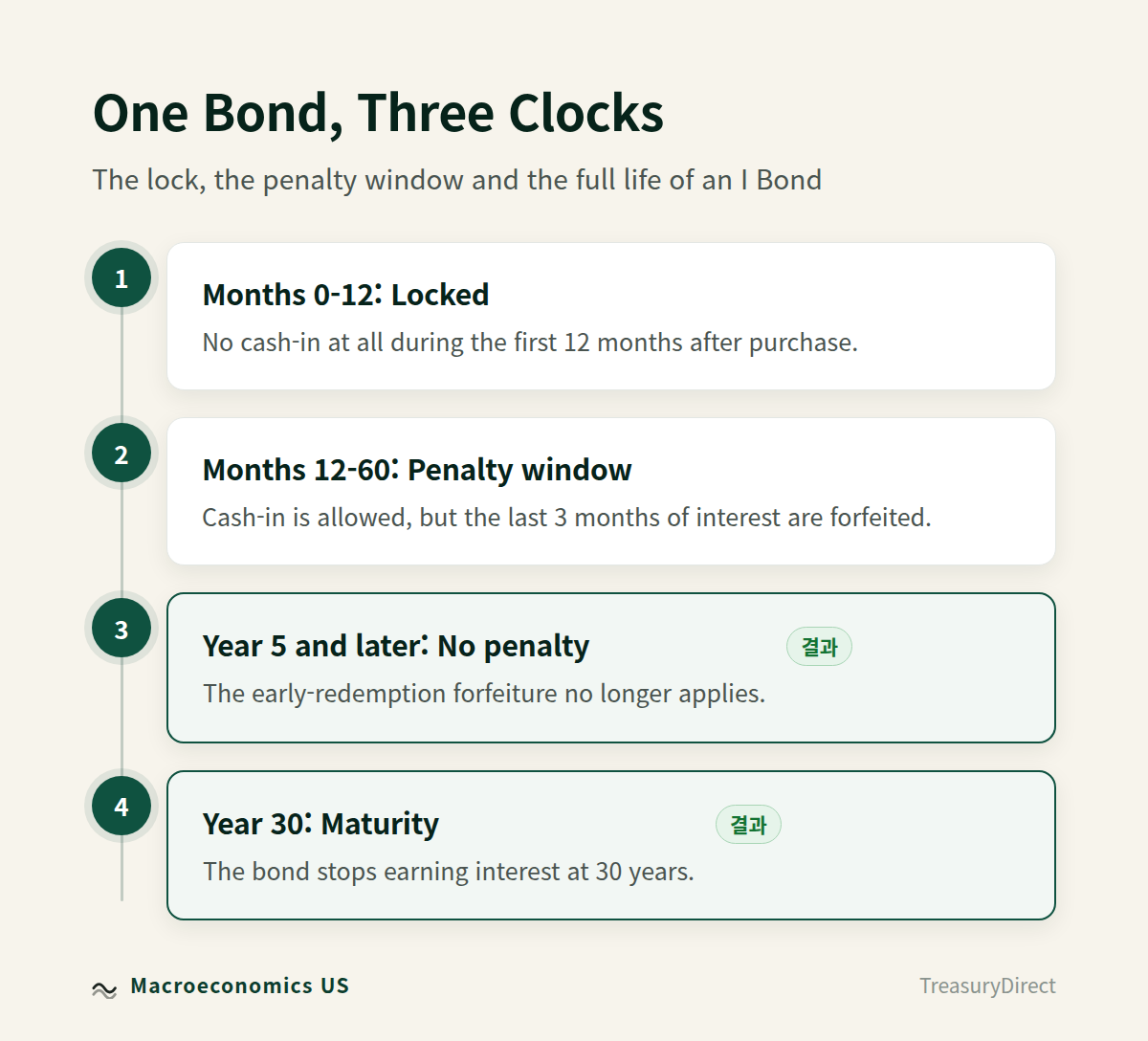
You cannot cash in an I Bond during its first 12 months. That is a hard stop, not a fee you can choose to pay. It makes I Bonds a poor fit for emergency cash or for any expense with a due date inside the year, such as a tax payment, a tuition bill or a down payment.
Count 12 full months from your purchase date. A bond bought in October 2026 stays locked until at least October 2027 by that count.
Reader math: Amount you can lock = Total savings - Emergency fund - Expenses due in the next 12 months. Your ceiling is the smaller of that figure and the $10,000 annual limit. If the result is zero or negative, the answer for now is none.
Three quick questions to test the result:
- Could a job change, medical bill or home repair force a withdrawal before month 13?
- Is this money already covering a dated expense inside the next 12 months?
- Could you still pay your regular bills if this money were out of reach for a year?
The minimum purchase is $25, so a smaller first purchase is possible if you are unsure about your 12-month needs.
Where the lock sits in the bigger picture:
- Months 0 to 12: no cash-in.
- After 12 months and before 5 years: cash-in is allowed, but the last 3 months of interest are forfeited.
- At 5 years or later: the forfeiture for earlier cash-ins no longer applies.
Mistake 3: Ignoring the 5-Year Interest Penalty
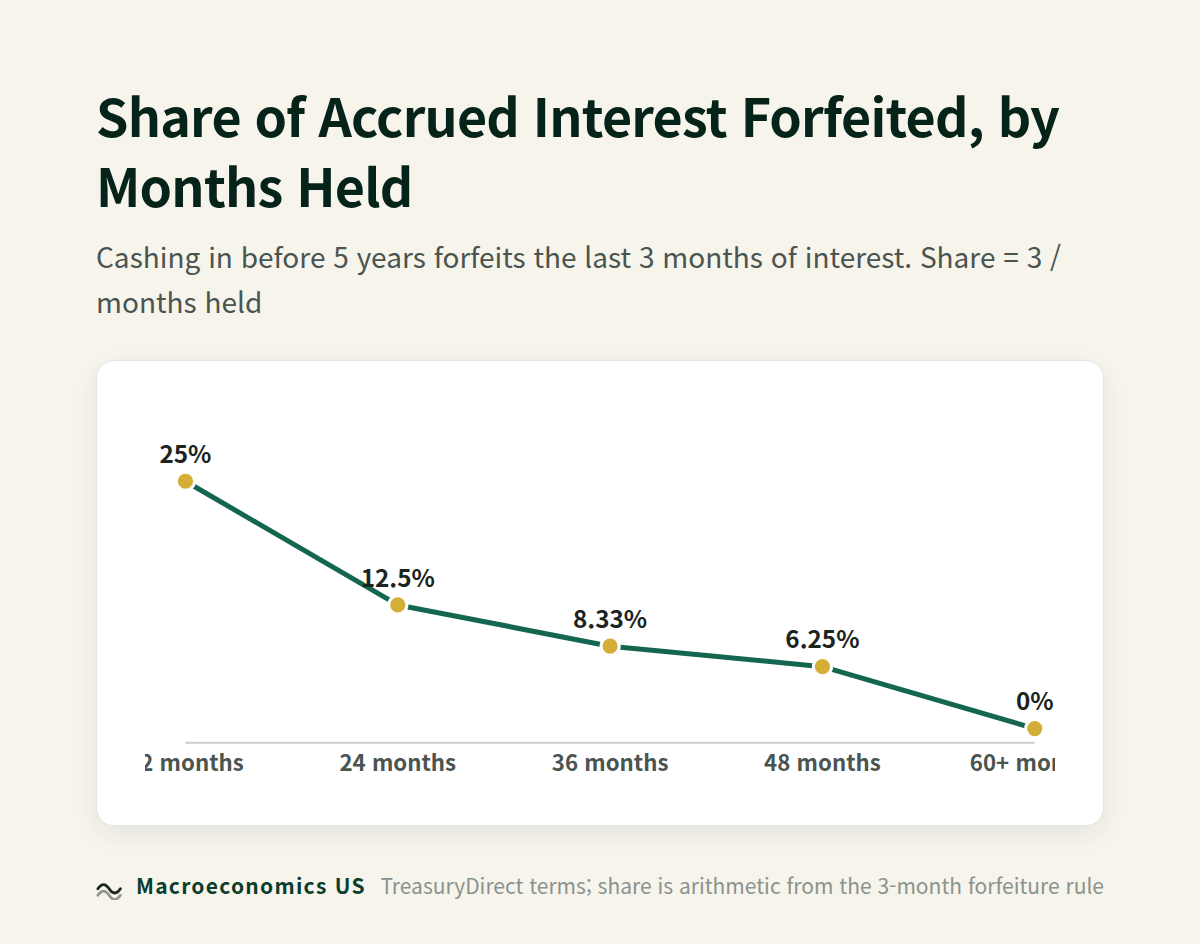
After month 12 you can cash in, but cashing in before 5 years forfeits the last 3 months of interest. That is a known cost, so price it before you buy, not after you need the money.
Percent math: if you hold for m months at a steady rate, the share of your accrued interest that is forfeited is about 3 ÷ m. Dollar math: the forfeiture is about Balance × Annual rate × 3 ÷ 12. On $10,000 at 4.26% (the rate for bonds issued May 1 to October 31, 2026), that is $106.50 [ESTIMATE: $10,000 × 4.26% × 3 ÷ 12 = $106.50; ignores compounding and assumes the rate stays at 4.26%, though it resets every six months].
The two views give different intuitions. At a steady 4.26%, the dollar forfeiture is the same $106.50 whether you cash in at month 12 or month 48, but the share of your interest it takes shrinks the longer you hold.
| Months held | Share of accrued interest forfeited | Effective annualized rate at a steady 4.26% |
|---|---|---|
| 12 | 25.00% | 3.20% |
| 24 | 12.50% | 3.73% |
| 36 | 8.33% | 3.91% |
| 48 | 6.25% | 3.99% |
| 60 or more | 0% | 4.26% |
[ESTIMATE: share = 3 ÷ months held; effective rate = 4.26% × (months held - 3) ÷ months held. For 60 months or more, the forfeiture applies only to cash-ins before 5 years, so the share is 0% and the rate is the full 4.26%. Rule-of-thumb, not a forecast: the rate resets every six months and the table ignores compounding.]
How to use it: if there is a real chance you will cash in between month 12 and month 60, compare the effective rate in the last column, not the 4.26% headline, with what your next-best option would pay over the same stretch. If you expect to hold 5 years or longer, you are planning around the penalty instead of paying it.
The November 1 numbers are not known yet, so build the decision around what you control. Work through these in order and pause at the first test your money fails.
The November 1 Update Box: Which Numbers to Recheck First
- Cash test. Is every dollar you plan to buy safe from needs in the next 12 months? If not, reduce the amount or leave that money out.
- Horizon test. Do you expect to hold at least 5 years? If not, check the effective-rate table above first, because a cash-in before 5 years forfeits the last 3 months of interest.
- Room test. How much of this year's $10,000 limit have you already used? Purchases before and after November 1 in 2026 share it, and a new calendar year starts a new limit. The minimum purchase is $25.
- Fixed-rate test. Is 0.90% acceptable to you for the life of the bond? If yes, buying before the window closes locks it in. If you would rather see the new fixed rate first, you accept whatever it turns out to be, higher or lower. Write down your plan for a higher, equal or lower fixed rate now.
- Regret test. If you cannot choose, a split purchase could limit regret: part before the window closes, part after the announcement. My read: that only makes sense if the total passes tests 1 to 3.
- Tax test. Interest is subject to federal income tax but exempt from state and local income tax. Compare I Bonds with alternatives after tax, and check your own situation, because this is general information.
Baseline in this article, as of October 23, 2026, for bonds issued May 1 to October 31, 2026 (source: [TreasuryDirect](https://www.treasurydirect.gov/savings-bonds/i-bonds/i-bonds-interest-rates/)). After the announcement, recheck in this order:
- New fixed rate vs. 0.90%. It is the only number that stays with a new bond. Yearly dollar gap ≈ Amount × (New fixed - 0.90%) [ESTIMATE].
- New semiannual inflation vs. 1.67%. My read: it drives the part of your rate that resets.
- New composite vs. 4.26%. Plug the new numbers into Fixed + 2 × Inflation + (Fixed × Inflation ÷ 100). If your result differs from the published composite by more than rounding, recheck your inputs.
- The dates the new rates cover. Confirm the issue window before you buy.
- Your 2026 limit. Add up purchases so far this calendar year against the $10,000 per-person limit.
- Your own clocks. For each bond you hold, note the reset month (every 6 months from its issue month), the 12-month lock date and the 5-year mark.
- The rules. Reconfirm the 12-month lock, the 3-month forfeiture before 5 years and the $25 minimum on [TreasuryDirect](https://www.treasurydirect.gov/savings-bonds/i-bonds/) before you buy.
- Next action. Write down your fixed-rate plan today. The headline rate resets; the fixed rate stays.
Comments
Post a Comment