The $25,000 Retirement Tax Trap: Why More Social Security Can Become Taxable Without a New Law
$25,000 of provisional income is the line where a single filer's Social Security benefits can start becoming taxable, and that figure has never been adjusted for inflation. Benefits rise with cost-of-living adjustments (COLAs) while the line stays fixed, so you can owe tax on more of your benefits in a year when no law changed. If you collect Social Security plus other income, such as IRA withdrawals or interest, the sections below give you the thresholds, a formula for your own numbers, and a year-end review list.
The Thresholds That Never Got an Inflation Adjustment
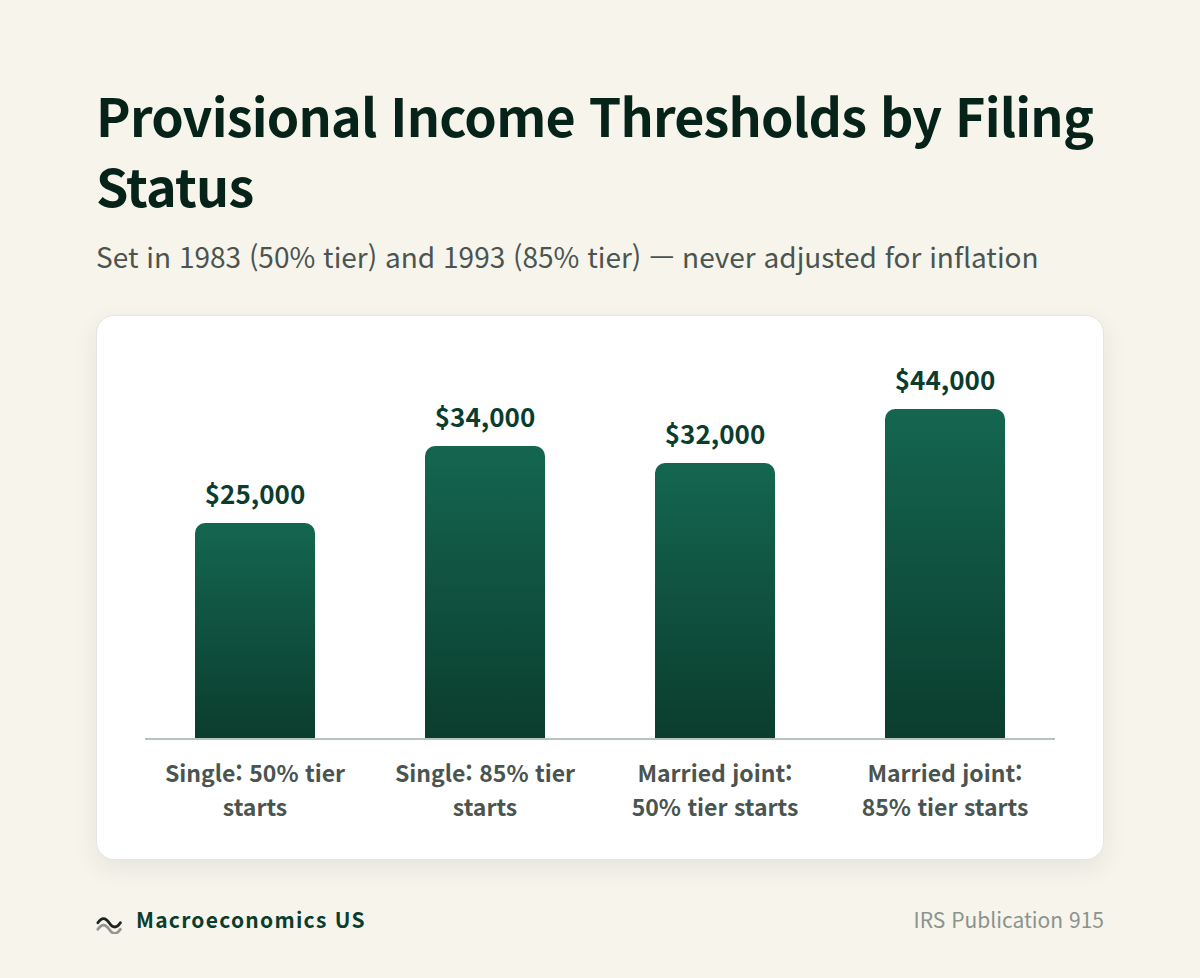
Whether any of your benefits are taxable depends on a number called provisional income (also called combined income), which the next section breaks down. The IRS compares that number with two thresholds, and the thresholds depend on your filing status. This article covers single filers and married couples filing jointly. Other filing statuses are not covered, so check the IRS instructions for yours.

Here are the thresholds and what each tier means, as of October 23, 2026:
| Provisional income | Single | Married filing jointly | Share of benefits that can be taxable |
|---|---|---|---|
| Below the first threshold | Below $25,000 | Below $32,000 | None |
| Between the two thresholds | $25,000 to $34,000 | $32,000 to $44,000 | Up to 50% |
| Above the second threshold | Above $34,000 | Above $44,000 | Up to 85% |
Source for thresholds and tiers: [IRS Publication 915, Social Security and Equivalent Railroad Retirement Benefits](https://www.irs.gov/publications/p915).
Read "up to" literally. It is a ceiling on the share of benefits that can be included in taxable income, not a tax rate. Section 4 explains the difference.
The timeline is short:
- 1983: the thresholds behind the 50% tier were set.
- 1993: the thresholds behind the 85% tier were set.
- October 23, 2026: neither set has ever been adjusted for inflation.
Your benefits behave differently. They rise with COLAs, so the dollars counted against a fixed line grow. Over time, more retirees cross the lines. This article describes that mechanism without putting a number on it.
How Provisional Income Actually Works
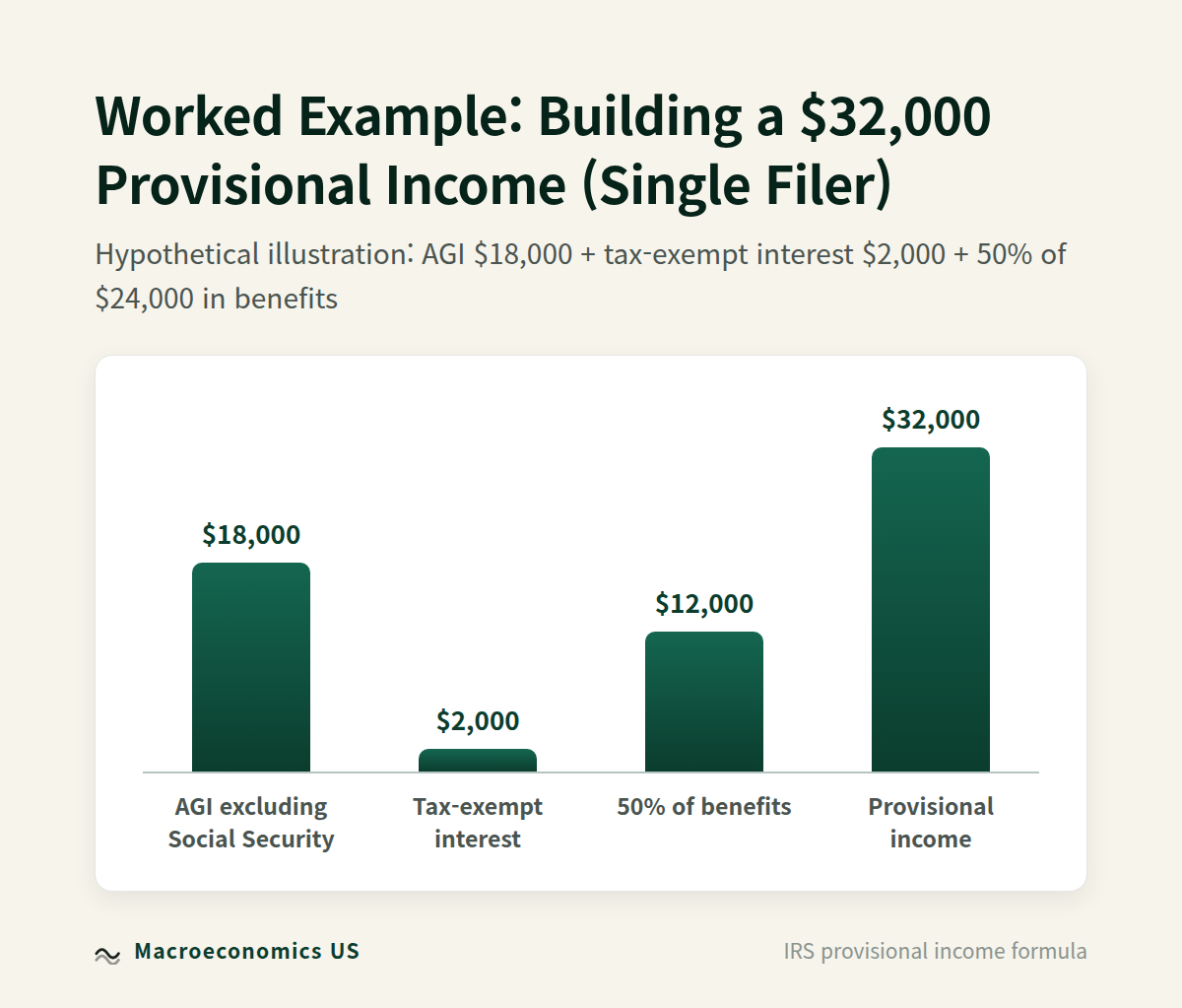
The formula has three parts:
Provisional income = AGI excluding Social Security + tax-exempt interest + 50% of your Social Security benefits
- AGI excluding Social Security. This is your adjusted gross income with Social Security left out. Everything else in it counts dollar for dollar, including IRA withdrawals that are included in your AGI and interest you report as income.
- Tax-exempt interest. Municipal bond interest still counts here. The label "tax-exempt" does not remove it from this formula.
- 50% of your Social Security benefits. Half of your annual benefits goes into the total. The other half does not.
Per dollar, other income moves provisional income twice as far as benefits do. Percent math: other income counts at 100%, benefits at 50%. Dollar math: $1,000 more in AGI adds $1,000, while $1,000 more in benefits adds $500.
Illustration only. The numbers below are hypothetical round figures chosen to show the arithmetic of the formula for a single filer. They are not data, and they are not a tax calculation for any real person.
| Line | Hypothetical amount |
|---|---|
| A. AGI excluding Social Security | $18,000 |
| B. Tax-exempt interest | $2,000 |
| C. Social Security benefits for the year | $24,000 |
| D. 50% of benefits (C × 0.50) | $12,000 |
| Provisional income (A + B + D) | $32,000 |
For a single filer, $32,000 falls between $25,000 and $34,000, so up to 50% of benefits can be taxable in this illustration. The headroom, meaning the distance to the next threshold, is $34,000 minus $32,000, or $2,000. Now change one input at a time:
| Change to the illustration | Provisional income | Tier (single filer) |
|---|---|---|
| Baseline above | $32,000 | Up to 50% |
| Add $3,000 of IRA withdrawals included in AGI | $35,000 | Up to 85% |
| Add $3,000 of tax-exempt interest instead | $35,000 | Up to 85% |
Both changes land in the same place because the formula treats a dollar of AGI and a dollar of tax-exempt interest the same way. The last row could surprise a retiree who bought municipal bonds to keep interest out of the tax picture.
Reader math: plug in your own numbers.
- Write down line A (AGI excluding Social Security) and line B (tax-exempt interest).
- Write down line C, your annual benefits, and multiply it by 0.50 to get line D. If you have not started benefits yet, use your expected annual benefit.
- Add A + B + D. That is your provisional income.
- Subtract it from your next threshold. That is your headroom.
For married filing jointly, use $32,000 and $44,000. If your provisional income is already above the second threshold, there is no higher tier left to cross.
The Hidden Tax Increase Without a Tax Rate Hike
In this mechanism, no tax rate changes and no new law passes. What changes is the amount of benefits and other income counted against thresholds that stay fixed. That fixed line is the "trap" in the title. Whether your tax bill actually rises depends on your own income and rate. Here is the chain, with the fixed numbers as of October 23, 2026:
- Event: Your benefits rise with a COLA. This article does not estimate its size.
- Transmission: 50% of the increase flows into provisional income, because benefits count at 50%.
- Fixed lines: The thresholds stay at $25,000 and $34,000 (single) or $32,000 and $44,000 (married filing jointly).
- Headroom: If your other income is unchanged, headroom shrinks by half of the benefit increase.
- Wallet impact: If provisional income crosses a line, the share of benefits that can be included in taxable income moves from none to up to 50%, or from up to 50% to up to 85%. Included benefits are then taxed at your regular rate.
Percent math: 50% of each benefit increase passes into provisional income. Dollar math: every $100 of added benefits adds $50.
Rule-of-thumb, not a forecast: next year's headroom = this year's headroom minus 0.50 × (benefit increase) minus (increase in other income and tax-exempt interest), assuming the thresholds stay as they are. Using the Section 2 illustration, where headroom is $2,000, a $1,000 increase in benefits for any reason, with other income unchanged, would cut headroom to $1,500 [ESTIMATE: $2,000 minus 0.50 × $1,000]. That is formula arithmetic on hypothetical inputs, not a COLA forecast.
My read: this mechanism resembles what is known as bracket creep. A dollar threshold stays fixed while the dollar amounts measured against it grow. Think of a high-water mark painted on a dock piling in 1983. If the water slowly rises and nobody repaints the mark, the water crosses it more often, even though the mark never moved.
My read: because no rate changes and no new law passes, this kind of increase could be easy to miss until a tax return is prepared. That is a reason to check your provisional income each year instead of assuming last year's result carries forward.
50% and 85%: The Two Numbers Readers Confuse With a Tax Rate
The 50% and 85% figures are not tax rates. They are the maximum share of your benefits that can be included in your taxable income. The included amount is then taxed at your regular rate. Step 1: the tier sets the cap on included benefits. Step 2: your regular rate applies to the included amount.
Think of a restaurant that adds a 10% service charge to 85% of your bill. The 85% describes which part of the bill the charge applies to. The charge is still 10%.
The words "up to" matter. In the 50% tier, up to half of your benefits can be included. In the 85% tier, up to 85% can be included. Percent math: at least 15% of your benefits stay out of taxable income in the 85% tier, and at least 50% stay out in the 50% tier.
Rule-of-thumb, not a forecast: the ceiling on tax from benefits is benefits × inclusion cap × your regular rate, assuming one rate applies to the whole included amount. The example below reuses the Section 2 illustration ($24,000 of benefits) with a hypothetical regular rate of 10%, chosen only to keep the arithmetic readable.
- Percent math: the included share times your rate gives the share of your benefits that could end up as tax. That is at most 5% of benefits in the 50% tier [ESTIMATE: 50% × 10%] and at most 8.5% in the 85% tier [ESTIMATE: 85% × 10%].
- Dollar math: up to $12,000 of the $24,000 could be included in the 50% tier [ESTIMATE: $24,000 × 50%] and up to $20,400 in the 85% tier [ESTIMATE: $24,000 × 85%]. At 10%, that is up to $1,200 [ESTIMATE: $12,000 × 10%] or up to $2,040 [ESTIMATE: $20,400 × 10%]. The ceiling rises by $840 between the tiers [ESTIMATE: $2,040 minus $1,200].
Those figures are ceilings built on a hypothetical rate, not a prediction for your return. The exact included amount depends on where your provisional income falls, and this article does not reproduce the full IRS calculation. Your regular rate could be higher or lower than 10%.
Why Middle-Income Retirees Feel It First
The IRS rules do not say how many retirees this affects, and this article does not guess. What the formula does show is who sits near the lines. I use "middle-income" loosely: a retiree whose provisional income lands near a threshold, not a dollar range.
Start with a retiree whose only income is Social Security, with no tax-exempt interest. Provisional income is then 50% of benefits. To pass the $25,000 single-filer line, benefits alone would have to exceed $50,000 [ESTIMATE: $25,000 ÷ 0.50]. For a married couple filing jointly, the line is $32,000, so benefits alone would have to exceed $64,000 [ESTIMATE: $32,000 ÷ 0.50]. This is formula arithmetic, not data about anyone's benefits.
My read: for a retiree whose benefits are below those amounts, other income, such as IRA withdrawals or interest, is what could carry provisional income toward the first line, and the formula counts those dollars at twice the weight of benefits.
My read: retirees near a line feel it first. A COLA, a little more interest, or a slightly larger IRA withdrawal could carry them across, while a retiree far below the first threshold has more headroom to absorb the same changes. A retiree already above the second threshold has crossed both lines and has no higher tier left to cross. As COLAs accumulate, the retirees closest to the lines could cross first and those with more headroom later, if at all.
My read: retirees who chose municipal bonds for their tax-exempt interest could be caught off guard, because that interest counts toward provisional income, as the last scenario in Section 2 shows.
What to Review Before Year-End
This is general information, not personal advice. Not covered here: the IRS calculation for the exact taxable amount, filing statuses other than single and married filing jointly, and state tax rules. If you file on a calendar-year basis, the review window closes on December 31, 2026. AGI is figured for each tax year, so the year an item of income lands in matters.
- Confirm your benefits. Use your total Social Security benefits for the year. Only 50% enters the formula.
- Total your other income so far (line A). Add everything in your AGI except Social Security that you have received to date, including IRA withdrawals that are included in AGI and interest.
- Add tax-exempt interest (line B). Municipal bond interest counts.
- Project the rest of the year. Add what you still expect to receive before December 31 to lines A and B.
- Compute provisional income and headroom. Add A + B + 50% of benefits, then subtract the total from your next threshold: $25,000 or $34,000 for single filers, $32,000 or $44,000 for married filing jointly.
- Review pending IRA withdrawals. A withdrawal included in your AGI adds to provisional income dollar for dollar. Whether to change the amount or timing of a withdrawal depends on your whole situation, including tax and financial effects this article does not cover, so raise it with a tax professional before acting.
- Check interest timing. Ask your bank or broker which tax year your interest will be reported in. Interest reported in a later year counts toward that later year's provisional income instead.
- Confirm your filing status. The thresholds in this article apply to single filers and married couples filing jointly only.
Next action: before December 31, 2026, fill in lines A through D with your own numbers and write down your headroom. The thresholds have never been adjusted for inflation, so your distance from them is the number worth tracking.
Comments
Post a Comment