Don't Prepay 100% of Your Tax Bill: The Safe Harbor That Could Save You From Penalties
Two benchmarks set your target for avoiding an underpayment penalty: 90% of this year's tax or 100% of last year's tax, whichever is smaller. If your income jumped this year, the second number could sit well below your full bill, so prepaying 100% of this year's tax may be more than the rules ask. Whatever you do not prepay is still due when you file, and this article covers the math, the 110% exception, and a checklist for the January 15, 2027 deadline.
*General information only, not personal tax advice. This article covers the safe-harbor targets and timing rules in [IRS Publication 505](https://www.irs.gov/publications/p505) and [Form 2210](https://www.irs.gov/forms-pubs/about-form-2210) as of October 23, 2026. It does not walk through the form line by line.*
The Fear: A Bigger Income Year and a Penalty You Didn't Expect

Your income grew faster than you planned. A larger client, a side project that took off, a few extra contracts: the cause matters less than the worry that follows. You suspect the tax you have paid in so far may not keep pace with your bill, and an underpayment penalty on top of a bigger bill is the surprise you want to avoid.
The instinct is to overcorrect: estimate this year's full tax and send all of it in before the January 15, 2027 deadline. My read: that could tie up cash earlier than the rules ask. The penalty test does not measure you against 100% of this year's tax. It measures you against two benchmarks, and the one that applies to you could be far lower than your bill.
One distinction runs through everything below. The two benchmarks are safe harbors, and meeting a safe harbor removes the penalty only. The remaining balance is still due when you file. The sections ahead cover the benchmarks, the 110% exception, why last year's number is easier to plan around, what counts toward the target, and a payment checklist.
The Two Benchmarks: 90% of This Year vs. 100% of Last Year (Use the Smaller)
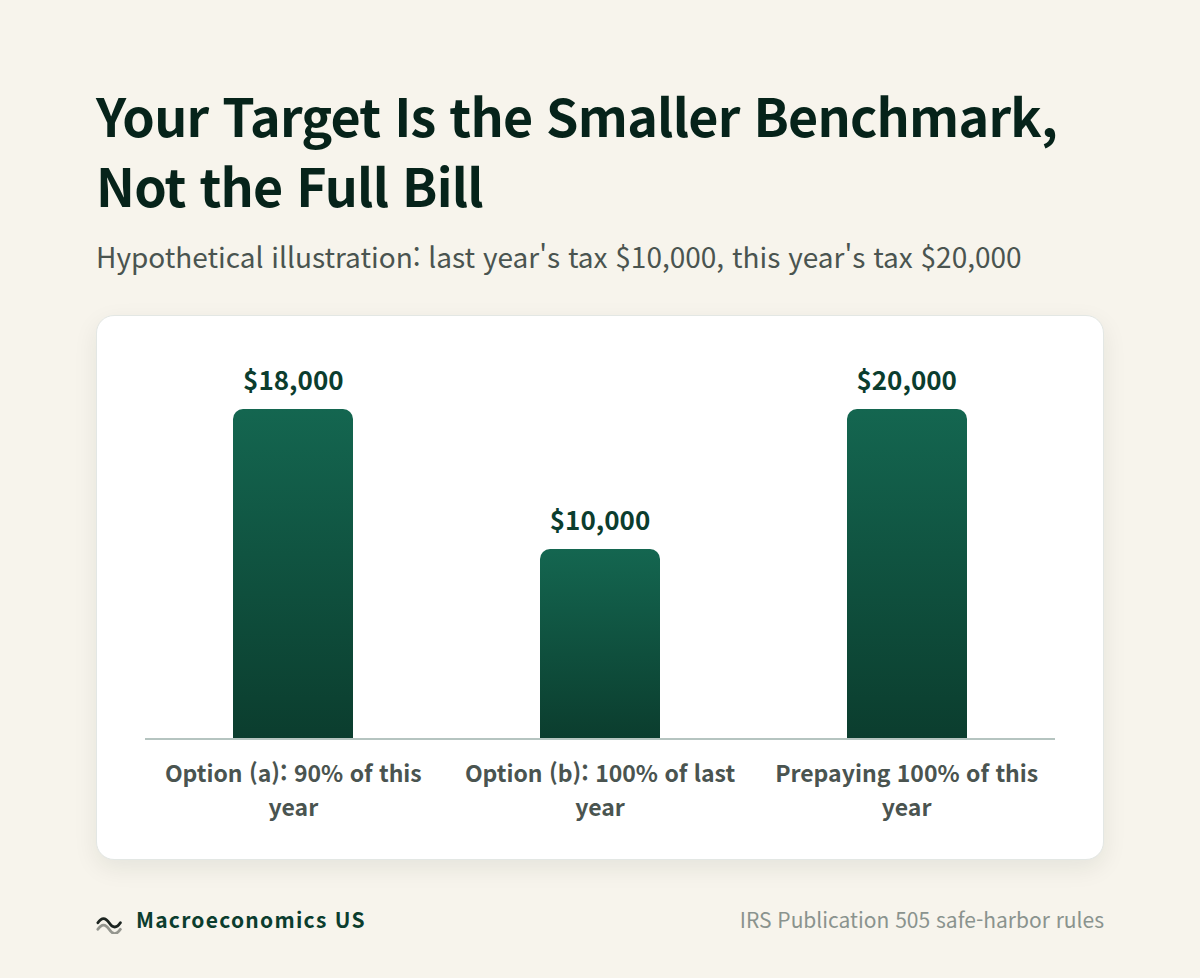
To avoid an underpayment penalty, your required annual payment is the smaller of two numbers:
- Option (a): 90% of the tax shown on this year's return.
- Option (b): 100% of the tax shown on last year's return.
Whichever is lower is your target. Because you take the smaller number, the target cannot exceed option (a), so the rules do not ask you to prepay all of this year's tax. Below, "this year's tax" means the tax shown on this year's return, which you work out as a projection until you file, and "last year's tax" means the tax shown on last year's return.
Formula to reuse: Target = the smaller of (0.90 × this year's tax) and (1.00 × last year's tax). The 110% exception below changes the second multiplier.
[ESTIMATE] Hypothetical illustration, a rule-of-thumb and not a forecast of your tax: last year's return showed $10,000 of tax, and this year's tax comes to $20,000 because your income jumped. Assume last year's adjusted gross income (AGI) was low enough that the 110% exception, covered next, does not apply, so option (b) uses 100%.
| Benchmark | Formula | Dollars [ESTIMATE] | Share of this year's tax |
|---|---|---|---|
| Option (a) | 0.90 × $20,000 | $18,000 | 90% |
| Option (b) | 1.00 × $10,000 | $10,000 | 50% ($10,000 ÷ $20,000) |
| Your target (the smaller) | smaller of $18,000 and $10,000 | $10,000 | 50% |
| Prepaying all of this year's tax | 1.00 × $20,000 | $20,000 | 100% |
[ESTIMATE] Follow the chain from income jump to wallet, one number per step:
- Event: your income jumps, and this year's tax comes to $20,000 against $10,000 last year.
- Transmission: option (a) rises to $18,000 (0.90 × $20,000), while option (b) stays at $10,000 because last year's return does not change.
- Wallet impact: the smaller number sets your target at $10,000, which is $10,000 less than prepaying the full $20,000.
[ESTIMATE] Percent math and dollar math give different pictures. Percent math: your target is 50% of this year's tax ($10,000 ÷ $20,000), which is 40 percentage points below the 90% benchmark (90% − 50%). Dollar math: it is $8,000 below option (a) ($18,000 − $10,000) and $10,000 below full prepayment ($20,000 − $10,000). Notice where the savings come from. Option (a) at $18,000 is only $2,000 under full prepayment ($20,000 − $18,000). In this illustration, option (b) does the heavy lifting.
When 100% Becomes 110%: The Prior-Year AGI Test
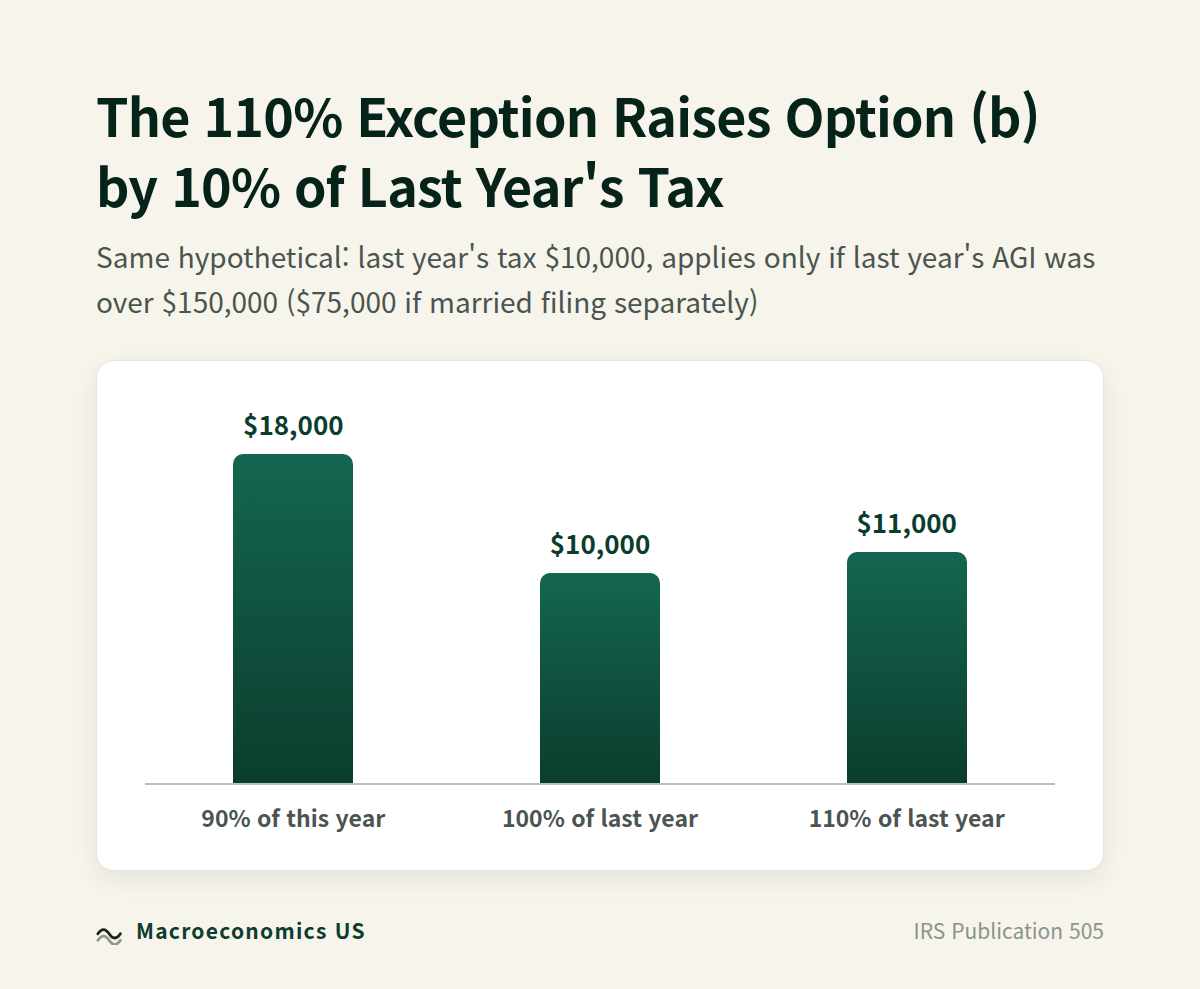
Option (b) has an exception. As of October 23, 2026, if last year's return showed AGI over $150,000 ($75,000 if you are married filing separately), option (b) becomes 110% of last year's tax instead of 100%. Call that threshold the line.
The test uses last year's AGI, not this year's. That could matter a lot after an income jump. If last year's AGI was at or below the line, option (b) stays at 100%, even if this year's AGI lands far above it. The reverse also holds: if last year's AGI was over the line and this year's income fell, option (b) is still 110%.
| Filing status | Last year's AGI | Option (b) uses |
|---|---|---|
| All other filing statuses | $150,000 or less | 100% of last year's tax |
| All other filing statuses | Over $150,000 | 110% of last year's tax |
| Married filing separately | $75,000 or less | 100% of last year's tax |
| Married filing separately | Over $75,000 | 110% of last year's tax |
The lower line matters if you are married filing separately. An AGI over $75,000 but not over $150,000 triggers the 110% for a married-filing-separately return and does not for other filing statuses. The rule says over, so an AGI exactly on the line does not trigger the exception.
Keep the two numbers on last year's return separate. The tax shown sets the dollar amount of option (b). The AGI only decides whether the multiplier is 100% or 110%.
Reader math with the exception: Target = the smaller of (0.90 × this year's tax) and (multiplier × last year's tax), where the multiplier is 1.00, or 1.10 if last year's AGI was over $150,000 ($75,000 if married filing separately). When option (b) is the smaller number, the exception adds 0.10 × last year's tax to your target.
Why Last Year's Number Is the One You Can Actually Know
Option (a) depends on the tax shown on this year's return, and that number is not final until you file. If your income arrives in uneven pieces, any projection could move, and one that runs low could leave you under 90% of the real figure.
Option (b) has no such problem. Last year's return already exists, so both inputs, the tax shown and the AGI that decides between 100% and 110%, are on a document you can pull today. Think of last year's tax as a printed receipt and this year's tax as a bill still being added up.
My read: because your required annual payment is the smaller of the two options, on-time payments that reach option (b) could satisfy the requirement even if this year's tax ends up above your projection.
[ESTIMATE] Rule-of-thumb, not a forecast: option (b) at 100% becomes the smaller number once this year's tax is more than last year's tax divided by 0.90. Call that tipping point the break-even. Percent math: 1.00 ÷ 0.90 = about 1.11, so this year's tax needs to run about 11% above last year's. Dollar math: on the hypothetical $10,000, the break-even is $10,000 ÷ 0.90 = about $11,111. With the 110% exception, the break-even is 1.10 ÷ 0.90 = about 1.22 times last year's tax, about 22% higher, or $11,000 ÷ 0.90 = about $12,222 on the same hypothetical.
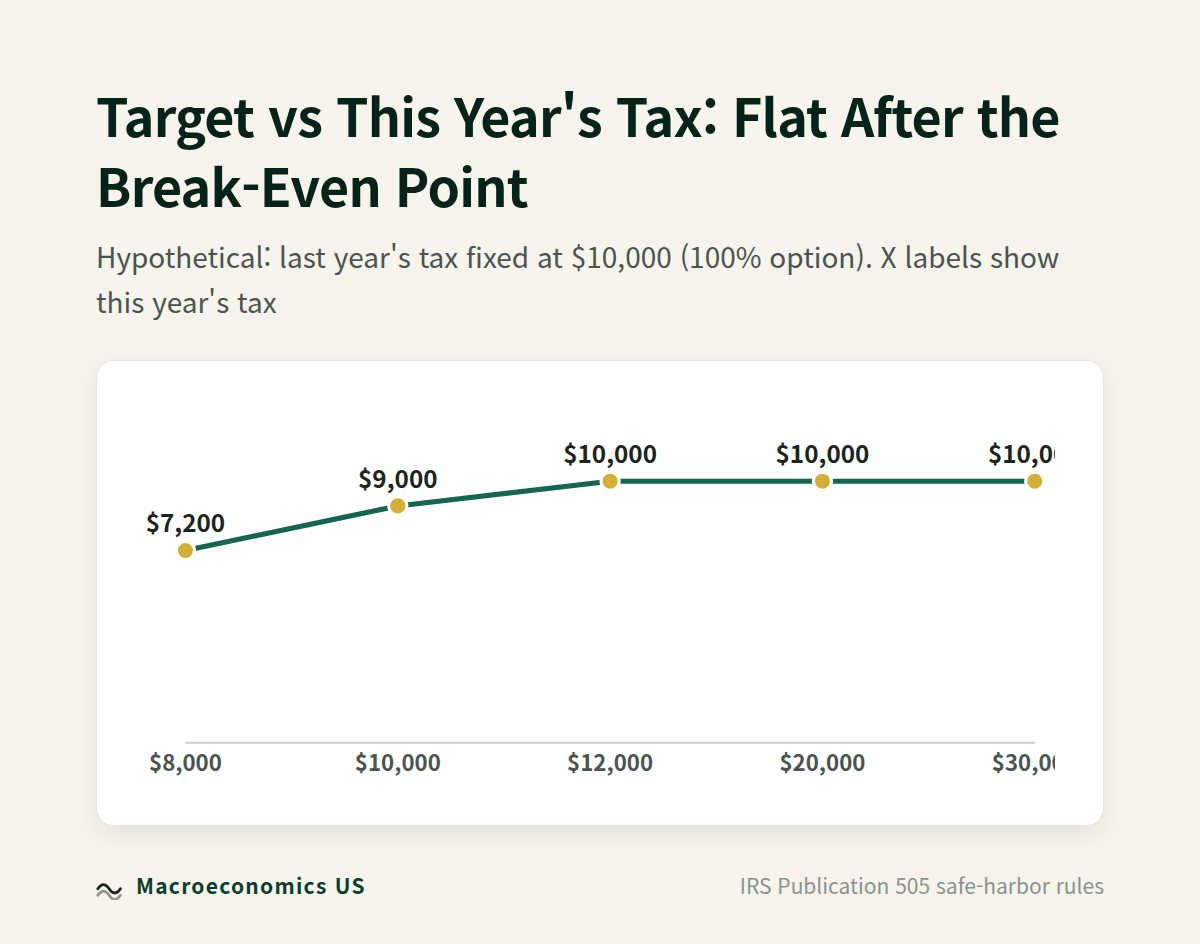
[ESTIMATE] The table shows how the target behaves as this year's tax changes, using the hypothetical $10,000 of last-year tax at 100%.
| This year's tax | Option (a): 0.90 × tax | Option (b): 1.00 × $10,000 | Target (smaller) | Target as share of this year's tax (rounded) |
|---|---|---|---|---|
| $8,000 | $7,200 | $10,000 | $7,200 | 90% |
| $10,000 | $9,000 | $10,000 | $9,000 | 90% |
| $12,000 | $10,800 | $10,000 | $10,000 | 83% ($10,000 ÷ $12,000) |
| $20,000 | $18,000 | $10,000 | $10,000 | 50% ($10,000 ÷ $20,000) |
| $30,000 | $27,000 | $10,000 | $10,000 | 33% ($10,000 ÷ $30,000) |
[ESTIMATE] Percent math: the target is 90% of this year's tax until the tax passes the break-even point, then it shrinks as a share of the bill (83%, 50%, 33% in the table, rounded). Dollar math: past the break-even point, the target stays at $10,000 in this illustration, however much higher this year's tax goes.
My read: after an income jump, this year's tax could clear that break-even easily, which could make last year's number the one to plan around.
The same logic runs forward. Next year, this year's return becomes last year's return, so option (b) would rest on this year's tax and the AGI test would use this year's AGI. My read: if this year's AGI ends up over $150,000 ($75,000 if married filing separately), next year's option (b) could move to 110%.
One condition keeps option (b) available: last year's return needs to have covered a full 12 months. If it did not, option (b) does not apply. My read: that leaves option (a) as the only benchmark.
What Counts Toward the Target (withholding + estimated payments) and What Safe Harbor Does NOT Do
What counts. Withholding counts toward these totals together with estimated payments. If you have a paycheck next to your side income, add its withholding to your [estimated payments](https://www.irs.gov/businesses/small-businesses-self-employed/estimated-taxes) before you compare the total with your target.
Reader math: Still to cover = target − withholding − estimated payments made so far. [ESTIMATE] With the hypothetical $10,000 target, $2,000 withheld, and $5,000 in estimated payments so far, $10,000 − $2,000 − $5,000 = $3,000 is still to cover.
What safe harbor does not do.
- It does not reduce your tax. Meeting a safe harbor removes the penalty only. The remaining balance is still due when you file. [ESTIMATE] In the illustration, paying in exactly the $10,000 target against $20,000 of tax leaves $10,000 due at filing ($20,000 − $10,000).
- It does not fix late payments. Each quarterly installment is judged on its own timing, and one large late payment does not erase underpayment in earlier quarters. It works like rent: a big payment at the end of the year does not make the earlier months on time. [ESTIMATE] If the whole $10,000 target arrived in one payment on January 15, 2027, the total would match the target, yet the earlier quarters could still show underpayment.
One rule comes before the benchmarks. As of October 23, 2026, no penalty applies if the amount owed after withholding is under $1,000. If your numbers land there, the targets above do not decide whether you owe a penalty.
My read: since the unpaid balance is still due when you file, the cash you do not prepay could work better as a tax reserve than as spending money. Setting aside the gap between your projected tax and your target could keep filing day from being a surprise. [ESTIMATE] In the illustration, that gap is $20,000 − $10,000 = $10,000.
- Run the $1,000 check. Estimate what you will owe after withholding. If it is under $1,000, no penalty applies.
- Pull last year's return. Write down the tax shown on it and last year's AGI.
- Confirm it covered a full 12 months. If it did not, option (b) is not available.
- Pick the multiplier. Use 1.00 if last year's AGI was $150,000 or less ($75,000 if married filing separately). Use 1.10 if it was over.
- Compute both options. Option (a) is 0.90 × your best projection of this year's tax. Option (b) is your multiplier × last year's tax.
- Take the smaller number. That is your target.
- Add up what counts. Total your withholding and estimated payments so far, then subtract that total from your target. The remainder is still to cover. If the remainder is zero or negative, your total already reaches the target, and step 8 still applies.
- Check the quarters. Each installment is judged on its own timing, so a payment on January 15, 2027 is on time for the fourth quarter only. It does not erase underpayment in earlier quarters.
- Plan the balance. Whatever you leave unpaid is still due when you file. Set aside the gap between your projected tax and your target.
- Start with step 2 today. Last year's return is already on paper, and it holds both numbers that set your option (b) target.
As of October 23, 2026, the next (fourth-quarter) deadline is January 15, 2027, which puts the earlier installments behind you. Work through the list in order to find your target and see what is left to cover.
Comments
Post a Comment