Your RMD Is Due December 31 — and the 2027 401(k) Limit Is $25,500
TLDR: Two IRS dates matter before the year ends. If you are 73 or older, your 2026 required minimum distribution (RMD) must leave your tax-deferred retirement accounts by December 31 — miss it and the IRS charges 25% of the shortfall. Separately, the IRS announced on November 12 that the 2027 401(k) limit rises to $25,500, up $1,000 from $24,500, while the IRA limit stays at $7,500. Below: how to compute your RMD in one division, what the penalty really costs on a real balance, and the three moves that cut the tax bill before the deadline.

Two dates, one deadline
The last six weeks of the year carry two separate retirement deadlines, and they point in opposite directions. One is money that must come out of your accounts. The other is room for money to go in next year.
The money-out deadline is December 31, 2026. That is the last day to take your 2026 required minimum distribution from traditional IRAs, 401(k)s, and similar tax-deferred accounts if you have reached RMD age. The IRS does not grant extensions on this one — the distribution has to be out of the account by year-end, not merely requested. (Source: IRS, Retirement Plan and IRA Required Minimum Distributions FAQs.)
The money-in news arrived two days ago. On November 12, 2026, the IRS announced the 2027 cost-of-living adjustments for retirement plans in news release IR-2026-136 and Notice 2026-66: the 401(k) elective deferral limit rises to $25,500, up $1,000 from $24,500 in 2026, while the IRA limit stays at $7,500. The new limits apply to contributions made in calendar year 2027 — they change nothing about what you can still contribute for the rest of 2026. (Source: IRS, IR-2026-136, November 12, 2026.)
That split is the point of this post. The 2027 limits are a planning number for January. The RMD is a hard deadline for December. If you are 73 or older, handle the RMD first — it is the one with a penalty attached.
The 2026 vs 2027 limits, side by side
The IRS sets these limits every November. Here is what changes and what does not, with the 2026 figures from IR-2025-111 and Notice 2025-67 and the 2027 figures from IR-2026-136 and Notice 2026-66.
| Limit | 2026 | 2027 |
|---|---|---|
| 401(k), 403(b), 457, TSP employee deferral | $24,500 | $25,500 |
| Catch-up, age 50 and over | $8,000 | $8,500 |
| Catch-up, ages 60–63 | $11,250 | $11,750 |
| Maximum at age 50 and over | $32,500 | $34,000 |
| Maximum at ages 60–63 | $35,750 | $37,250 |
| Overall defined-contribution limit (employee + employer) | $72,000 | $75,000 |
| IRA (traditional and Roth combined) | $7,500 | $7,500 |
| IRA catch-up, age 50 and over | $1,100 | $1,100 |
Sources for the table: IRS news release IR-2025-111 and Notice 2025-67 (2026 figures); IRS news release IR-2026-136 and Notice 2026-66 (2027 figures).
Two details are worth a second look. First, the 60-to-63 catch-up is a narrow SECURE 2.0 provision: only savers who turn 60, 61, 62, or 63 during the year qualify, and the higher amount replaces the standard catch-up rather than stacking on top of it. Second, the IRA limit did not move at all — $7,500 for the second straight year — so the 401(k) is where the new room appears. If your employer plan lets you change your deferral percentage during open enrollment, a raise set now takes effect with your first January paycheck.
One more timing note: you can make 2026 IRA contributions until April 15, 2027, but 401(k) deferrals have to come out of 2026 paychecks. If you still have 2026 room in a workplace plan, the window closes with your last December paycheck, not in April.
How big is your RMD?
The calculation is one division. Take your account balance on December 31 of last year and divide it by the IRS life-expectancy factor for your age from the Uniform Lifetime Table. That is your RMD for this year. (Source: IRS Publication 590-B; IRS RMD FAQs.)
The starting age depends on your birth year under the SECURE 2.0 Act: age 73 if you were born between 1951 and 1959, and age 75 if you were born in 1960 or later. Roth IRA owners have no RMDs during their own lifetime — the rule applies to tax-deferred accounts: traditional IRAs, SEP IRAs, SIMPLE IRAs, and most employer plans. (Source: IRS RMD FAQs.)
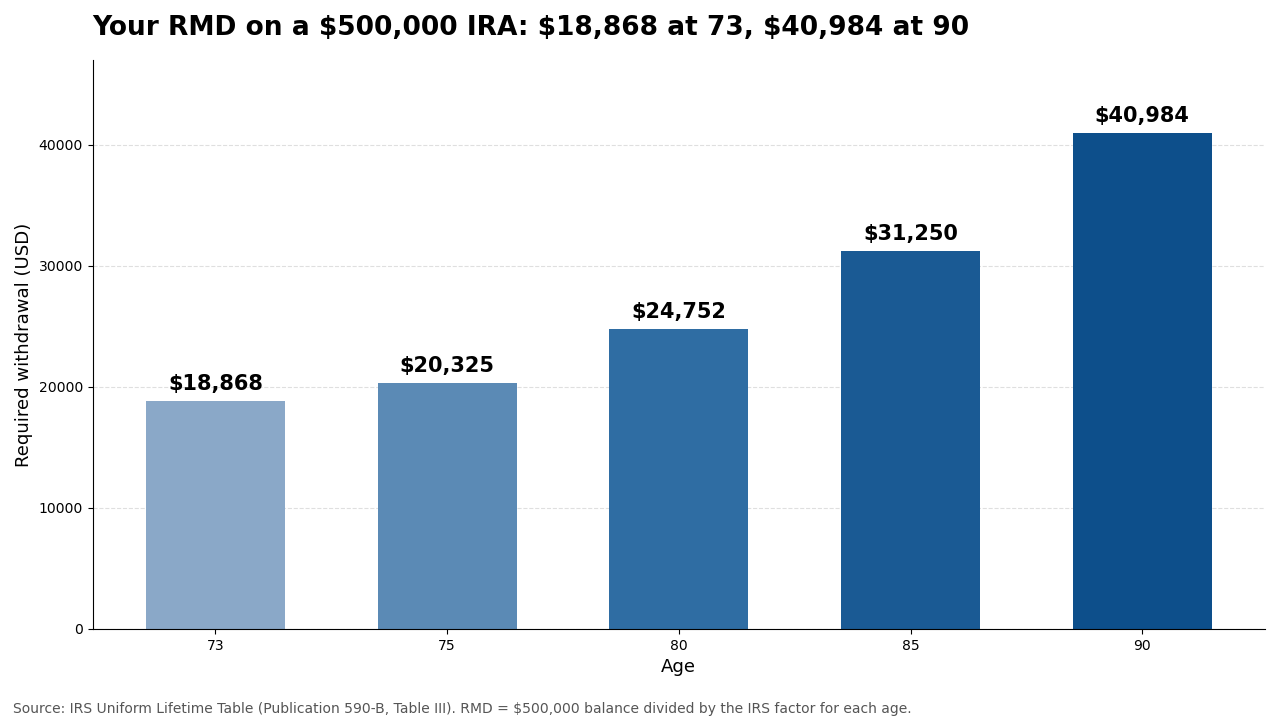
Here is what the division produces on a $500,000 balance, using the IRS Uniform Lifetime Table factors that have been in effect since 2022:
| Age in 2026 | IRS factor | RMD on $500,000 | Share of balance |
|---|---|---|---|
| 73 | 26.5 | $18,868 | 3.77% |
| 75 | 24.6 | $20,325 | 4.07% |
| 80 | 20.2 | $24,752 | 4.95% |
| 85 | 16.0 | $31,250 | 6.25% |
| 90 | 12.2 | $40,984 | 8.20% |
Sources for the table: IRS Uniform Lifetime Table (Table III, Publication 590-B); RMD amounts are the $500,000 balance divided by each factor — straight arithmetic, no estimates.
The pattern is the story. The factor shrinks every year, so the required withdrawal grows as a share of the balance even if the balance itself stays flat. At 73 the IRS asks for 3.77% of the account; by 90 it asks for 8.20%. That is why the RMD is not a one-year chore — it is a rising annual tax event, and the year you cross into it is the year to start planning around it rather than reacting to it.
A first-year exception exists, and it is a trap for the unwary. If 2026 is the first year you reach RMD age, the IRS lets you delay that first distribution until April 1, 2027. Taking the delay means two RMDs land in 2027 — the delayed 2026 one plus the regular 2027 one — and both count as 2027 income. For most people in that spot, taking the first RMD in December is the cleaner move. (Source: IRS RMD FAQs.)
Two more mechanics worth knowing. First, the balance that counts is the December 31, 2025 balance — not today's balance. A market drop in 2026 does not shrink this year's RMD. Second, if you hold several traditional IRAs, you add up the RMD for each one and may take the total from any of them; the same aggregation does not apply across 401(k) plans, where each plan's RMD must come out of that plan. (Source: IRS RMD FAQs.)
The 25% penalty — and the 10% way out
Missing an RMD is expensive in a way that is easy to underestimate, because the penalty applies to the amount not withdrawn, not to the whole account. The SECURE 2.0 Act cut the old 50% penalty to 25% of the shortfall. If you correct the miss within two years — take the missed distribution and file IRS Form 5329 — the penalty drops to 10%. (Source: IRS RMD FAQs; IRS Publication 590-B.)
On the numbers above, the arithmetic is concrete. Skip the full $18,868 RMD on a $500,000 IRA at age 73 and the penalty is $4,717 — that is $18,868 times 0.25. Correct it within two years and the penalty is $1,887 — $18,868 times 0.10. The IRS can also waive the penalty entirely for reasonable cause, such as illness or faulty advice, if you ask in writing with Form 5329. None of that is automatic: the penalty is reported on Form 5329, and the waiver is a request, not a right.
The practical defense is boring and effective. Most custodians will automate the distribution — a fixed dollar amount or a calculated RMD paid monthly, quarterly, or in one December lump sum. Set the automation before December, confirm the first payment actually left the account, and keep the confirmation. An RMD that was "requested" but never left the account is still a missed RMD.
Three ways to shrink the tax hit
An RMD is taxable income, and there is no way to make it disappear. But three established moves change how much of it reaches your tax return — and all three have to happen before December 31.
First, the qualified charitable distribution. If you are 70½ or older, you can have your IRA custodian send up to $111,000 per person directly to a qualified charity in 2026, and none of it lands in your taxable income. The amount counts toward your RMD for the year. The 2026 cap rose from $108,000 in 2025 under IRS Notice 2025-67, and a married couple where each spouse gives from their own IRA can reach $222,000 combined. Three conditions are absolute: the transfer must go directly from trustee to charity — a check written after a cash withdrawal does not qualify — the recipient must be a qualified 501(c)(3) organization, and donor-advised funds, private foundations, and supporting organizations are excluded. The transfer has to be completed by December 31 to count for 2026. (Source: IRS Notice 2025-67; IRS Publication 590-B.)
Second, a Roth conversion — done in the right order. Converting some of a traditional IRA to a Roth IRA shrinks the balance that future RMDs are calculated on, because Roth IRAs have no RMDs for the owner. But the RMD itself cannot be converted: the required distribution has to come out first, and only money above the RMD can be moved to Roth. A conversion also adds to this year's taxable income, so the usual logic is to convert in a low-income year, not in the same year a large RMD already pushes income up. (Source: IRS RMD FAQs.)
Third, manage the withholding, not just the withdrawal. An RMD paid with no tax withheld can produce an underpayment surprise in April, including an estimated-tax penalty on top of the income tax. You can elect federal withholding on the distribution itself, or make an estimated payment before January 15. The withholding choice is free; the April surprise is not.

What to do before December 31
- Confirm your RMD amount with your custodian. The custodian's calculation uses your December 31, 2025 balance and the Uniform Lifetime Table — check it against your own division before you act on it.
- Take the distribution — or confirm the automation already did. A scheduled payment that never left the account is still a miss. Verify the money moved, not just that you asked for it.
- If you give to charity, route it as a QCD. The custodian sends it directly, up to $111,000 per person for 2026, and it counts toward the RMD without touching your taxable income.
- Use up 2026 contribution room while it exists. The 401(k) limit is $24,500 for 2026 and rises to $25,500 in 2027; IRA room is $7,500 either way. Workplace deferrals must come out of 2026 paychecks.
- Set your January deferral for the new limit. If you want the full $25,500 in 2027 — $34,000 at age 50 and over, $37,250 at ages 60 to 63 — change the election during open enrollment so the first January paycheck reflects it.
Frequently asked questions
When is my first RMD due?
If you were born between 1951 and 1959, RMDs begin at age 73; if you were born in 1960 or later, they begin at 75. Your first RMD is due by April 1 of the year after you reach that age, and every later RMD is due by December 31 of its year. Taking the first one in December instead of waiting until April avoids having two RMDs taxed in the same year. (Source: IRS RMD FAQs.)
What happens if I miss my RMD?
The IRS charges a 25% excise tax on the amount not withdrawn. If you take the missed distribution and file Form 5329 within two years, the penalty drops to 10%. The IRS may waive it entirely for reasonable cause if you ask in writing. On an $18,868 missed RMD, that is the difference between a $4,717 penalty and a $1,887 one. (Source: IRS Publication 590-B.)
Does a charitable distribution count toward my RMD?
Yes. A qualified charitable distribution of up to $111,000 per person in 2026 counts toward that year's RMD, and the amount is excluded from your taxable income. The transfer must go directly from your IRA custodian to a qualified charity, you must be 70½ or older on the date of the transfer, and it must be completed by December 31. Donor-advised funds cannot receive a QCD. (Source: IRS Notice 2025-67; IRS Publication 590-B.)
Do Roth IRAs have RMDs?
Not for the owner. Roth IRA owners have no required minimum distributions during their lifetime, which is why Roth conversions are a standard way to shrink future RMDs — the converted money leaves the RMD calculation entirely. Inherited Roth IRAs follow separate beneficiary rules. (Source: IRS RMD FAQs.)
Can I still contribute to a 401(k) or IRA in 2026?
Yes. The 2026 limits — $24,500 for a 401(k), $7,500 for an IRA — apply through December 31, 2026. Workplace deferrals must come out of 2026 paychecks, but IRA contributions for 2026 can be made until April 15, 2027. The 2027 limits ($25,500 for a 401(k), $7,500 for an IRA) apply only to money contributed in 2027. (Source: IRS IR-2025-111; IRS IR-2026-136.)
The bottom line
December 31 is a real deadline with a real penalty: 25% of whatever RMD you leave in the account, $4,717 on a typical $18,868 first-year distribution. The 2027 limits are good news — $25,500 of 401(k) room, $34,000 at 50 and over — but they belong to January. The move that matters now is the unglamorous one: confirm the number, move the money, and check that it actually left the account.
2026 RMD deadline: December 31, 2026 (first RMD may wait until April 1, 2027 — at the cost of two RMDs in one tax year)
Penalty for a miss: 25% of the shortfall; 10% if corrected within two years (Form 5329)
QCD cap for 2026: $111,000 per person, direct trustee-to-charity only
2027 401(k) limit: $25,500 ($34,000 at 50+, $37,250 at 60–63); IRA stays at $7,500
RMD formula: December 31, 2025 balance ÷ IRS Uniform Lifetime Table factor
"The RMD is the one retirement deadline with a penalty attached — confirm the number, move the money, and check that it actually left the account."
What is your RMD this year — and did your custodian's number match your own calculation? Tell us in the comments.
This is educational content, not financial advice. Consider consulting a licensed advisor.
Related reading on this blog: our Roth IRA income limits for 2026 explains the $153,000–$168,000 phase-outs and why Roth money escapes RMDs; our Social Security COLA breakdown shows how the 2026 raise interacts with the Medicare premium that eats part of it; how to check your exact January 2027 Social Security check walks through the 3.6% increase; and our look at the Fed's December 9 decision covers the rate backdrop your savings and borrowing costs sit in.
Sources
- IRS, 401(k) limit increases to $25,500 for 2027, IRA limit remains $7,500 (IR-2026-136, November 12, 2026) — irs.gov
- IRS, Notice 2026-66, 2027 cost-of-living adjustments for retirement plans (November 12, 2026) — irs.gov
- IRS, 401(k) limit increases to $24,500 for 2026, IRA limit increases to $7,500 (IR-2025-111, November 13, 2025) — irs.gov
- IRS, Notice 2025-67, 2026 cost-of-living adjustments for retirement plans (November 13, 2025) — irs.gov
- IRS, Retirement Plan and IRA Required Minimum Distributions FAQs — irs.gov
- IRS, Publication 590-B, Distributions from Individual Retirement Arrangements (Uniform Lifetime Table, Table III; RMD penalty rules)
- SmartAsset, IRA Required Minimum Distribution (RMD) Table for 2026 — smartasset.com (Uniform Lifetime Table factors, retrieved November 14, 2026)
Comments
Post a Comment