Social Security COLA 2026: Your $56 Raise and the $17.90 Catch
TLDR
The 2.8% cost-of-living adjustment lifts the average retired worker's Social Security benefit from $2,015 to $2,071 a month starting in January 2026 — about $56 more. But the standard Medicare Part B premium rises $17.90 at the same time, from $185.00 to $202.90, so the average retiree who pays the standard premium keeps $38.10 of that $56. Your exact amount is in your COLA notice — check it in your my Social Security account.
Social Security checks went up in January 2026. If yours looked bigger, it was — and if it did not look $56 bigger, there is a reason, and it is printed on the same notice as the raise. The Social Security Administration (SSA) announced a 2.8 percent cost-of-living adjustment (COLA) for 2026, and the Centers for Medicare & Medicaid Services (CMS) set the standard Medicare Part B premium at $202.90 a month for the same year. The two numbers arrive together, in the same check, and the second one takes a bite out of the first. This post works through both, with the official figures and the arithmetic, so you can see exactly what changed in your own payment.

The 2026 numbers at a glance
The COLA is not a number SSA picks by hand. By law it follows the Consumer Price Index for Urban Wage Earners and Clerical Workers (CPI-W), comparing the average for July, August and September 2025 with the same three months of 2024. That measured increase was 2.8 percent, and SSA announced it on October 24, 2025. The increase applies to benefits payable in January 2026; Supplemental Security Income (SSI) recipients saw it on December 31, 2025. Nearly 71 million Social Security beneficiaries are affected, and about 75 million Americans receive Social Security or SSI. Here is what the adjustment did to the average monthly benefit for each group, straight from SSA's 2026 COLA fact sheet:
| Beneficiary group | Before COLA (2025) | After COLA (Jan 2026) | Monthly increase |
|---|---|---|---|
| All retired workers | $2,015 | $2,071 | +$56 |
| Aged couple, both receiving benefits | $3,120 | $3,208 | +$88 |
| Widowed mother and two children | $3,792 | $3,898 | +$106 |
| Aged widow(er) alone | $1,867 | $1,919 | +$52 |
| Disabled worker, spouse and one or more children | $2,857 | $2,937 | +$80 |
| All disabled workers | $1,586 | $1,630 | +$44 |
Source: SSA, 2026 COLA Fact Sheet — "Estimated Average Monthly Social Security Benefits Payable in January 2026."
The $56 figure for the average retired worker is SSA's own number: its press release says retirement benefits "will increase by about $56 per month starting in January." The average is exactly that — an average across millions of retirees. Your own increase is 2.8 percent of your own benefit, so a $1,500 check rises about $42 and a $2,500 check rises about $70. The percentage is the same for everyone; the dollars are not.

The Part B catch: where $17.90 of the raise goes
For most retirees, the Medicare Part B premium comes straight out of the Social Security payment before the money arrives. That makes the premium increase part of the same calculation as the raise. CMS set the standard monthly Part B premium for 2026 at $202.90, which the agency's own notice describes as "9.7 percent or $17.90 higher than the 2025 standard premium rate of $185.00." The annual Part B deductible rises too, from $257 to $283 — $26 more before Part B starts paying its 80 percent share.
Run the two numbers together for the average retired worker:
- Gross benefit: $2,015 → $2,071, up $56 a month.
- Part B premium: $185.00 → $202.90, up $17.90 a month.
- Net deposit: $1,830.00 → $1,868.10, up $38.10 a month.
Over a full year, that is $672 more in benefits, $214.80 more in Part B premiums, and $457.20 more actually deposited. About 32 percent of the average COLA dollar goes to the premium increase. The same arithmetic applies to every household, scaled to its own benefit:
- Aged couple, both on Medicare: benefits up $88, two standard premiums up $35.80, net gain $52.20 a month.
- Aged widow(er) alone: benefit up $52, premium up $17.90, net gain $34.10 a month.
- Disabled worker: benefit up $44, premium up $17.90, net gain $26.10 a month.
There is one protection worth knowing. Under the hold-harmless rule, the Part B premium for most current enrollees cannot rise by more than the dollar amount of their Social Security COLA increase. If your benefit is small enough that the $17.90 premium rise would exceed your COLA dollars, your premium increase is capped at your COLA amount instead. New enrollees and higher-income beneficiaries who pay an income-related surcharge are not covered by that rule — for 2026 the surcharge applies above $109,000 of modified adjusted gross income for a single filer and $218,000 for a joint return.
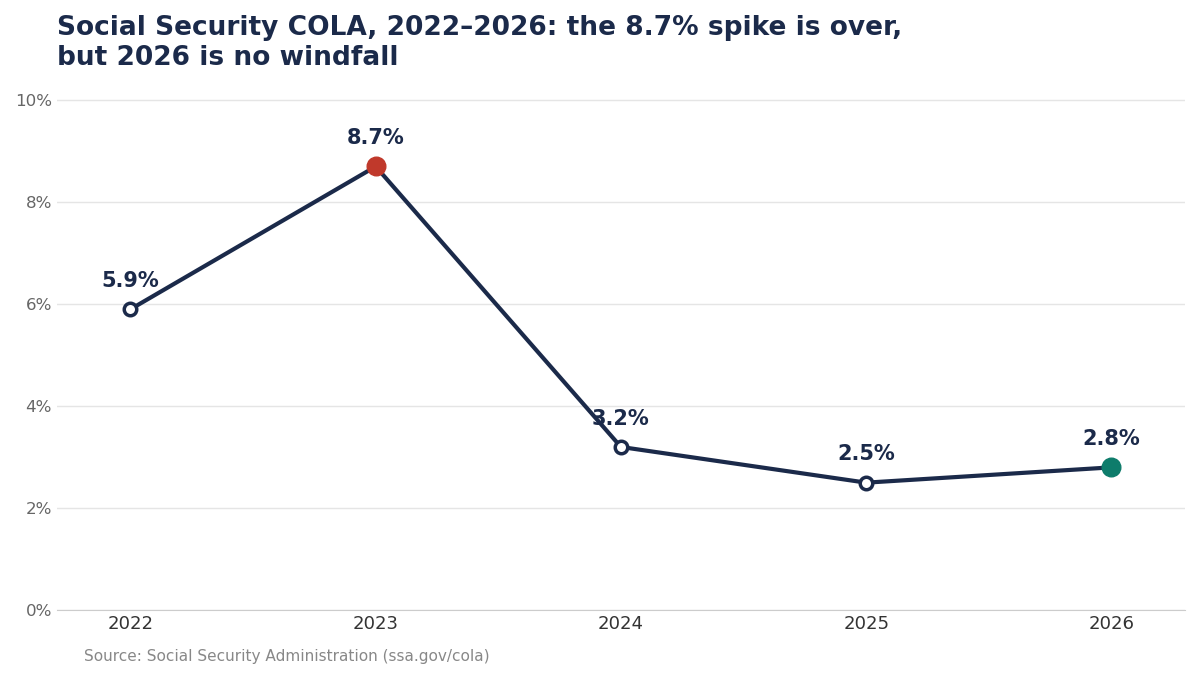
The five-year picture puts 2026 in context. The 8.7 percent COLA of 2023 was the largest in four decades, driven by the inflation spike; the two years since have been 2.5 and 2.8 percent. Over the last decade the COLA has averaged about 3.1 percent, so 2026 sits slightly below the recent norm — and the Part B premium, up 9.7 percent, rose more than three times as fast as the benefit it is deducted from. That gap is the whole story of the 2026 adjustment: a normal-sized raise meeting an unusually large premium increase.
Everything else that changed in January 2026
The COLA is the headline, but SSA's fact sheet lists several other January changes that touch workers and beneficiaries:
- Maximum benefit at full retirement age: $4,018 → $4,152 a month, up $134.
- Taxable maximum: earnings subject to the Social Security tax rise from $176,100 to $184,500 — $8,400 more of high earnings gets taxed.
- Earnings test, under full retirement age: you can earn up to $24,480 a year ($2,040 a month) before $1 in benefits is withheld for every $2 earned above the limit, up from $23,400.
- Earnings test, in the year you reach full retirement age: the limit rises to $65,160 a year ($5,430 a month), with $1 withheld for every $3 above it, until the month you reach full retirement age. Once you are full retirement age or older for the entire year, there is no earnings limit at all.
- SSI federal payment standard: $967 → $994 a month for an individual (up $27), and $1,450 → $1,491 for a couple (up $41).
- Quarter of coverage: $1,810 → $1,890 of earnings buys one credit toward insured status.
None of these changes your benefit by itself — they set the boundaries around it: how much you can earn while collecting, the most anyone can receive, and the most earnings that count toward the tax. If you are still working and collecting, the earnings-test limits are the numbers that matter most to you.
Three things to check before the year ends
1. Read your COLA notice. SSA mailed COLA notices starting in early December 2025, and most beneficiaries can also see theirs online in the Message Center of a my Social Security account. The notice is a single page with your exact new benefit amount and every deduction — it is the only document that shows your number rather than the average.
2. Check the premium actually deducted. The $202.90 figure is the standard premium. If you pay an income-related surcharge, a late-enrollment penalty, or a state Medicare Savings Program covers your premium, your deduction is different — and your net gain is different too. Compare the January deposit with the December one rather than assuming the average.
3. Mind the December deadlines around your benefits. Medicare Open Enrollment ends December 7, and if you have not checked your 2027 drug coverage, that deadline matters more than the COLA math — you are locked into your plan's 2027 terms for a year. And if you hold a health flexible spending account, unspent 2026 money is generally forfeited after December 31 unless your plan offers a carryover or grace period; see Your FSA Money Expires December 31 — the $680 Rule That Decides What You Keep. December is also when year-end tax moves pay off: Congress added four new deductions for 2025 that are claimed on the new Schedule 1-A, worth up to $72,000 combined — see 4 New IRS Deductions Worth Up to $72,000 — Claim Them on Schedule 1-A.
Looking ahead: the 2027 COLA is already set
SSA has announced that benefits will increase 3.6 percent in 2027, beginning with payments in January 2027, for about 76 million Americans. That is larger than the 2026 adjustment, and it will come with its own Part B premium announcement in the fall. The 2026 numbers in this post are the ones that decide your checks right now; the 2027 figure is a planning note, not money in hand.
Save this: the five numbers
- 2026 COLA: 2.8%
- Average retired worker benefit: $2,071 a month (up $56)
- Standard Part B premium: $202.90 a month (up $17.90)
- Net gain for the average retiree: $38.10 a month
- Part B deductible: $283 a year (up $26)
"The raise is real. The premium is real too. Count both before you count on either one."
Frequently asked questions
When did the 2026 COLA take effect?
With Social Security benefits payable in January 2026. SSI recipients saw the increase on December 31, 2025, because January 1 is a federal holiday. SSA announced the 2.8 percent figure on October 24, 2025.
Why is my check up less than 2.8 percent?
The COLA raises your gross benefit by 2.8 percent, but the Medicare Part B premium — up $17.90 to $202.90 — is deducted from the same check, along with any other withholding such as tax or an income-related surcharge. The net deposit rises by the COLA dollars minus the premium dollars. For the average retiree that is $56 minus $17.90, or $38.10.
Does the hold-harmless rule protect everyone from the premium increase?
No. It protects most current Part B enrollees whose Social Security benefit is their source of the premium deduction: their premium cannot rise by more than the dollar amount of their COLA increase. It does not cover new Medicare enrollees, people who do not have the premium deducted from Social Security, or the income-related surcharge paid by higher-income beneficiaries.
Where do I find my exact new amount?
In your COLA notice — by mail from early December 2025, or online in the Message Center of your my Social Security account. The notice lists your new benefit amount and every deduction. Averages in articles like this one cannot substitute for it.
Which number surprised you most — the $56 raise or the $17.90 premium? Tell us in the comments: did your January deposit match the math in this post?
This post is for general information only. It is not personal financial, tax, or legal advice. Benefit amounts and premiums are set by the Social Security Administration and the Centers for Medicare & Medicaid Services; your own amounts are in your COLA notice and your my Social Security account.
About the author: Daniel Kim
Daniel Kim writes about practical knowledge for everyday life and your wallet, from household money decisions to understanding the economy around you.
Sources
- Social Security Administration, "Social Security Announces 2.8 Percent Benefit Increase for 2026," press release, October 24, 2025 — ssa.gov/news/en/press/releases/2025-10-24.html
- Social Security Administration, "2026 Cost-of-Living Adjustment (COLA) Fact Sheet" — ssa.gov/cola/factsheets/2026.html
- Social Security Administration, "Cost-of-Living Adjustment (COLA) Information" — COLA history 2022–2027 — ssa.gov/cola
- Centers for Medicare & Medicaid Services, "Medicare Part B Monthly Actuarial Rates, Premium Rates, and Annual Deductible Beginning January 1, 2026" (CMS-8091-N), Federal Register Vol. 90, No. 221, November 19, 2025 — govinfo.gov/content/pkg/FR-2025-11-19/html/2025-20251.htm
- Railroad Retirement Board, "Medicare Part B Premiums and Deductibles Will Increase in 2026," November 2025 — rrb.gov/Newsroom/NewsReleases/MedicarePartBPremium
Comments
Post a Comment