Gas Prices Under $4 — But You Pay $710 More a Year
Gas Prices Under $4 — But You Pay $710 More a Year
TLDR: gas prices at a glance
Save this: Gas prices fell to a national average of $3.98 a gallon for regular gasoline on Tuesday, November 10, 2026 — the first reading below $4 since July 20, according to AAA. That is down from $4.15 a week ago and $4.37 a month ago. But the same gallon cost $3.07 a year ago, so a driver who fills a 15-gallon tank once a week is still paying about $710 more per year than last fall. Diesel has barely moved: $6.16 a gallon, against $3.74 a year ago. The drop is real relief, not a return to cheap gas — and the cheapest move this week is to fill up now rather than wait for a lower price that may not come.
Gas prices: the number that changed today
On Tuesday morning, November 10, 2026, the AAA national average for regular gasoline stood at $3.9788 a gallon, with AAA data reported by OilPrice. The U.S. Energy Information Administration tells the same story from its own weekly survey: regular gasoline fell to $3.995 in the week ending November 9, down 15.8 cents from the week before, according to EIA.
The direction matters because it has been one way for weeks. The EIA weekly series shows regular gasoline falling every week for five weeks, from $4.331 on October 12 to $4.284, $4.269, $4.153, and $3.995 on November 9 (see the chart below) — a steady decline, not a one-day move.
Two forces are doing the work. First, crude oil prices have eased: Brent crude futures briefly fell below $90 a barrel, its lowest level since August, according to the New York Post, after President Trump signaled he is not planning to strike Iran anytime soon.
Second, demand is falling with the season, and refineries are switching to cheaper winter-blend gasoline, which works through the system. Patrick De Haan, head of petroleum analysis at GasBuddy, predicts fuel prices will continue to ease into the Thanksgiving holidays, according to reporting on his forecast.
None of that makes gas cheap. It makes gas less expensive than it was a month ago, which is a different thing, and the difference is worth real money. A 15-gallon fill-up at today's $3.98 costs $59.70. The same fill-up a month ago at $4.37 cost $65.55. That is $5.85 back in your pocket on every tank. But the same fill-up a year ago at $3.07 cost $46.05 — $13.65 less than today. If you fill that 15-gallon tank once a week, the math for the year is $3,104.40 at today's price against $2,394.60 at last year's price. The gap is $709.80 a year, and it is still sitting in your budget even after today's good news.
What the gas prices drop is actually worth to you
The national average is an abstraction. Your tank is not. Here is what the move from $4.37 a month ago to $3.98 today is worth per fill-up, and what you are still paying above last year's $3.07, using simple multiplication on the verified prices. The arithmetic is ours; the prices are AAA's.
| Tank size | Today: $3.98/gal | You save vs. a month ago | You still pay vs. a year ago |
|---|---|---|---|
| 12-gallon tank | $47.76 | $4.68 | $10.92 |
| 15-gallon tank | $59.70 | $5.85 | $13.65 |
| 20-gallon tank | $79.60 | $7.80 | $18.20 |
| Weekly fill-up: 15 gallons, once a week (52 weeks) | $3,104.40 | $304.20 | $709.80 |
Source: AAA national averages, November 10, 2026 — $3.9788 today, $4.1493 a week ago, $4.3669 a month ago, $3.0744 a year ago. The weekly habit is one 15-gallon fill-up a week, 52 weeks a year. The fill-up is calculated on the unrounded prices, and is a cent or two different from multiplying by the rounded prices.
Read it this way: the $5.85 you save on every tank versus a month ago is real, but it is still less than half the $13.65 you are still paying extra versus a year ago. The year, not the month, is the bill that matters.
Gas prices: the five-week slide, in one picture
The chart below uses the EIA weekly series — regular gasoline, U.S. average, weeks ending October 12 through November 9, 2026. The five weeks are a straight line down, and the 15.8-cent drop in the last week is the largest of the five.
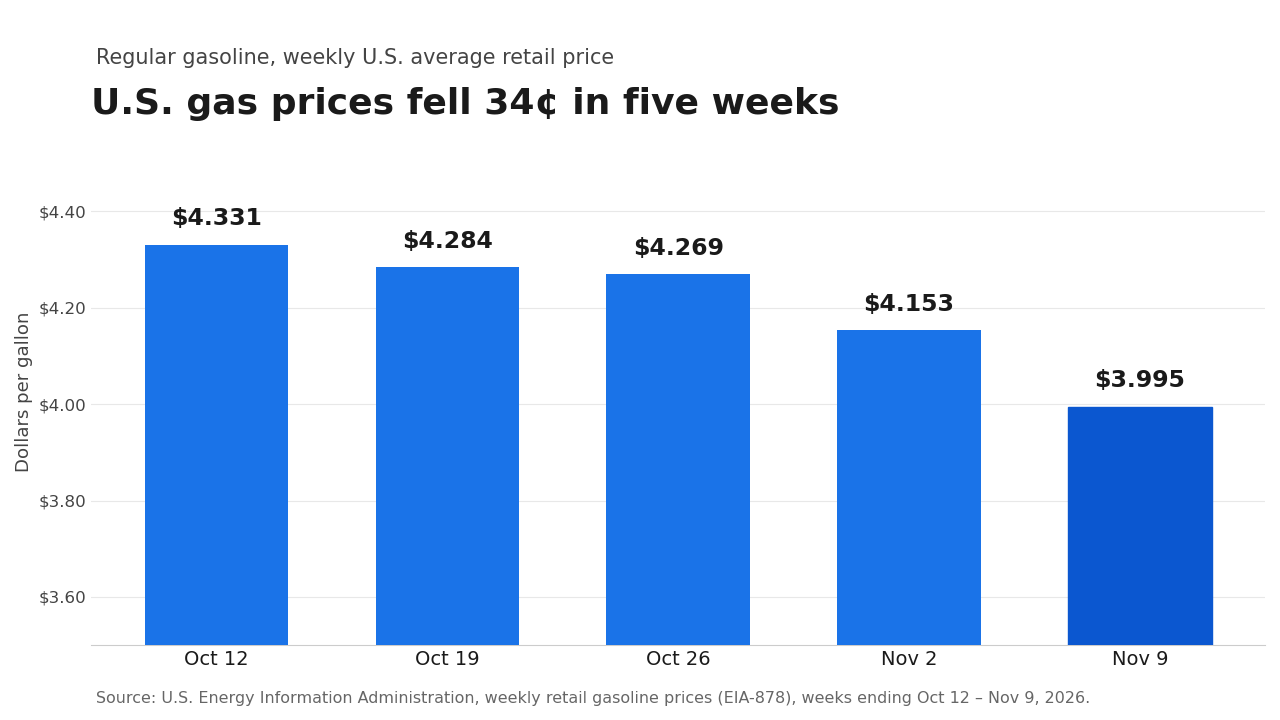
Source: U.S. Energy Information Administration, weekly retail gasoline prices (EIA-878), weeks ending October 12 through November 9, 2026. For context, the 2026 average so far is $3.88 a gallon across 45 weeks of EIA data, with a 2026 high of $4.50 in the week of May 11 and a low of $2.78 in the week of January 12, according to EIA data compiled by US Gas Gauge.
Put the five weeks in the longer frame and the picture sharpens. Gas started 2026 at $2.80 a gallon in the week of January 5, peaked at $4.50 in the week of May 11, and has averaged $3.88 across the year so far. Today's $3.98 sits almost exactly on the year's average — which means the market has given back the autumn spike, not the year's increase. The year began near $2.80 and the price is still $1.18 above that starting point. That is the number to keep in mind when a headline calls this a return to normal. Normal, by the year's own starting point, is still more than a dollar away.
Why gas prices fell — and what could push them back
Gasoline prices follow crude oil with a lag, and crude has been falling. The immediate trigger reported by the New York Post is a drop in Brent crude below $90 a barrel, its lowest level since August, after President Trump said he is not planning to strike Iran anytime soon, and Brent crude briefly fell below $90 a barrel for the first time since August, according to the New York Post. The same report notes that regular gasoline prices are still about 30 percent higher than they were before the United States and Israel launched strikes on Iran on February 28, and roughly 40 percent higher than at the beginning of this year.
The February 28 strikes are the hinge of the whole year. Regular gasoline is up 34 percent and diesel is up 64 percent since the United States attacked Iran on February 28, according to AAA data cited by USA Today. That single date explains why a price that feels like relief today still looks like a penalty against last year. The market priced in a supply shock in the spring, and it has been unwinding that shock in slow motion ever since.
Seasonality is the second driver, and it is the reliable one. Demand falls after summer, refineries switch to cheaper winter-blend gasoline, and prices usually ease into the end of the year. GasBuddy's De Haan expects the easing to continue into the Thanksgiving holidays. Joe Adamski of the supply-chain consultancy ProcureAbility told the New York Post that prices could stay below the $4 level until the spring, as he expects negotiations in the Middle East to continue, with a floor of $3.60 to $3.65 a gallon. A driver planning around a $3.60 floor should treat it as a possibility to hope for, not a price to count on. The practical move is to take the savings that are actually at the pump today rather than to wait for a forecast to arrive.
Diesel is the other story, and it is worse
While regular gasoline crossed below $4, diesel stayed far above it. The AAA national average for diesel was $6.1572 a gallon on November 10 — $6.16 in round numbers — compared with $3.7389 a year ago, according to AAA data reported by OilPrice. The EIA weekly survey puts diesel at $6.127 a gallon in the week ending November 9, down 17 cents from the week before, and $3.837 a year ago, according to the EIA report. Diesel is down from its late-September levels — it was $6.53 in late September, according to reporting on AAA data — but it is still up roughly 64 percent since February 28, the same AAA figure cited above.
Gas prices by state: California vs. North Carolina is a $37-a-tank gap
But the national average hides a spread of $2.47 a gallon. California drivers are paying $5.71 a gallon for regular — $85.65 for a 15-gallon fill-up — while North Carolina drivers are paying $3.24, or $48.60 a fill-up, according to AAA state averages for November 10, 2026. On a 15-gallon fill-up, that spread is $37.05 — more than the entire month-over-month saving the national average just delivered.
The spread is the story: California ($5.71) vs. North Carolina ($3.24) is $2.47 a gallon — $37.05 on a 15-gallon fill-up, more than the whole month-over-month saving the national average just delivered.
| State | Regular ($/gal) | 15-gallon fill-up | vs. national $3.98 |
|---|---|---|---|
| California | $5.71 | $85.65 | +$1.73 |
| Hawaii | $5.63 | $84.45 | +$1.65 |
| Nevada | $5.04 | $75.60 | +$1.06 |
| Washington | $4.98 | $74.70 | +$1.00 |
| New York | $4.23 | $63.45 | +$0.25 |
| Arkansas | $3.61 | $54.15 | −$0.37 |
| Mississippi | $3.64 | $54.60 | −$0.34 |
| Georgia | $3.46 | $51.90 | −$0.52 |
| Texas | $3.48 | $52.20 | −$0.50 |
| North Carolina | $3.24 | $48.60 | −$0.74 |
Source: AAA state averages, November 10, 2026, and EIA regional prices, week ending November 9, 2026. California is the most expensive state on both, at $5.71 on AAA and $5.56 on EIA; the Gulf Coast is the cheapest region on EIA at $3.48.
What to do this week, in order
Here is the short list, in the order that saves the most money first.
- Fill up now if your tank is below half. The saving is real money — $5.85 on a 15-gallon tank versus a month ago — and the price could climb back above $4 before the end of the month.
- Check your state's average against your station. If your regular station charges more than your state's average by more than a few cents, and another station is on your route, switch — the spread between states is $2.47 a gallon, and the spread between stations in the same town can be almost as large.
- If your car takes regular, use regular. Mid-grade and premium cost 30 to 40 cents more a gallon, and most cars that take regular see no benefit from higher octane — do not pay for octane you do not need, especially now that regular is back below $4.
- Do not stockpile gas in containers. Note the obvious safety rule that keeps getting repeated in every price spike: storing gasoline at home is dangerous and illegal in many places.
- If you are a diesel driver, check your route's price: diesel is $6.16 nationally, and the gap to regular is $2.18 — so do not plan a long trip around a $4 regular price you cannot use.
If you want a longer look at how the new deductions for 2025 through 2028 are worth a look before you file, see 4 New IRS Deductions Worth Up to $72,000 — Claim Them on Schedule 1-A.
Save this: the five numbers
- National average, regular: $3.98 (Nov 10, 2026) — first sub-$4 reading since July 20
- A month ago: $4.37 — a year ago: $3.07
- Still paying vs. last year: $710 more a year on a weekly 15-gallon fill-up
- Diesel: $6.16, vs. $3.74 a year ago
- Cheapest vs. priciest state: North Carolina $3.24 vs. California $5.71
Gas prices: frequently asked questions
Is gas really below $4 a gallon?
Yes, on the national average. AAA reported $3.9788 a gallon for regular on November 10, 2026, the first reading below $4 since July 20, and the EIA weekly survey independently reported $3.995 for the week ending November 9. Your local price may still be above $4 — the state averages run from $3.24 in North Carolina to $5.71 in California — so check your state's figure on the AAA state averages page rather than assuming the national number is yours.
How much am I actually saving?
Not cheap — less expensive. A 15-gallon fill-up at $3.98 costs $59.70, against $65.55 a month ago and $46.05 a year ago. The saving versus a month ago is $5.85 a tank, $304.20 a year on a weekly fill-up, and it is real. The extra versus a year ago is $13.65 a tank, $709.80 a year. That is why the headline is 'under $4' and the bill is still bigger.
Why did gas prices fall?
The drop in crude oil prices, and the seasonal fall in demand after summer. Brent crude briefly fell below $90 a barrel, its lowest level since August, after President Trump said he is not planning to strike Iran anytime soon. Refineries are also switching to cheaper winter-blend gasoline. Both forces are in the New York Post report and the USA Today, October 2026 CPI report.
Can I trust the $3.98 figure?
AAA's daily survey of stations, and the EIA's weekly survey of retail prices (EIA-878), cross-check each other. The AAA figure is $3.9788; the EIA figure is $3.995. Both are for regular gasoline, and both are cited with their dates in the sources below.
Sources
- AAA national average, November 10, 2026 ($3.9788; week ago $4.1493; month ago $4.3669): AAA Gas Prices
- AAA daily state averages, November 10, 2026: AAA state averages
- AAA national average and state averages, with the July 20 first sub-$4 date: OilPrice, AAA data
- EIA weekly retail gasoline and diesel prices, week ending November 9, 2026 (regular $3.995; diesel $6.127): EIA Gasoline and Diesel Fuel Update
- EIA weekly report (gas down 15.8 cents; diesel down 16.5 cents): United States Tribune, EIA data
- TrackRecord oil balances report: TrackRecord
- 2026 year-to-date average $3.88; high $4.50 (May 11); low $2.78 (Jan 12): US Gas Gauge, EIA data
- October CPI (+0.4% month over month; gasoline +1% in October vs. +9.1% in September; gasoline +34% and diesel +64% since February 28): USA Today, October 2026 CPI report
- Brent crude below $90, first time since August; potential floor $3.60–$3.65: New York Post
- GasBuddy forecast (prices to ease into Thanksgiving) and diesel $6.53 in late September: Europe Says report on AAA/GasBuddy data
- EIA regional prices, week ending November 9 (California $5.56; Gulf Coast $3.48): Modern Public Fleet, EIA data
- North Carolina $3.24 cheapest, California $5.71 most expensive, November 10: Energy Factbook, AAA data
All prices verified live on November 10, 2026. Per-fill and annual amounts are arithmetic on the cited AAA prices and are labeled as such. No forecast in this article is presented as a fact.
Comments
Post a Comment