Your Bank Account Is Insured to $250,000 — Until It Isn't: The 3 Rules That Decide What Actually Comes Back
If your bank failed tomorrow, how much of your money would come back? Most people answer with one number: $250,000. That number is real, but it is not the whole answer. The Federal Deposit Insurance Corporation does not insure $250,000 per account. It insures $250,000 per depositor, per insured bank, for each account ownership category. Those three extra words — per depositor, per bank, per category — are where money is either protected or left exposed, and they are the reason two people with the same balance at the same bank can have very different outcomes.
This post explains the rule in plain language, shows the arithmetic with worked examples, and gives you a 10-minute check you can run on your own accounts. All of the coverage figures below come from the FDIC's own estimator guidance. Where this post uses an example balance, it says so plainly: the example is arithmetic, not a claim about any real person's account.
The 3-part rule, in one paragraph
Start with the bank. Coverage is calculated separately at each FDIC-insured bank. A single account at Bank A and a single account at Bank B are each covered up to $250,000, even if both banks belong to the same holding company. Next, add up everything you hold in the same ownership category at the same bank. A checking account, a savings account, and a certificate of deposit in your name alone are not three separate $250,000 buckets. They are one bucket, added together, and covered up to $250,000 in total. Finally, change the category and you get a separate bucket. A single account, a joint account, and a retirement account at the same bank can each be covered separately, if all of the FDIC's requirements for those categories are met.
That last point is the one most people miss, and it cuts both ways. It means you can be covered for far more than $250,000 at a single bank without doing anything exotic — you only need accounts that genuinely fall into different categories. It also means you can be under-covered while believing you are safe, if you have spread money across several accounts that all fall into the same category.
What counts as a deposit, and what does not
FDIC insurance covers deposit products at an FDIC-insured bank: checking accounts, savings accounts, money market deposit accounts, and certificates of deposit. It covers principal plus interest accrued through the day the bank closes, up to the applicable limit for the category.
It does not cover investment products, even if you bought them at a bank. Stocks, bonds, mutual funds, exchange-traded funds, annuities, and crypto assets are not FDIC-insured deposits. The contents of a safe deposit box are not a deposit either. If a product's value can fall with the market, that fall is not an FDIC loss — and if a product is held through a bank's brokerage arm rather than as a bank deposit, it is judged under a different protection system, not FDIC deposit insurance. When in doubt, ask one question first: is this money a deposit at an FDIC-insured bank, or is it something the bank sold you that is not a deposit? That distinction decides whether the $250,000 rule even applies.
The categories that matter most
The table below uses only the FDIC's standard figures. Trust rules changed on April 1, 2024, merging revocable and irrevocable trust treatment into a single trust ownership category, so older explanations that treat them as fully separate categories are out of date.
| Ownership category | Coverage at one FDIC-insured bank |
|---|---|
| Single accounts (one owner) | $250,000 per owner, all single accounts combined |
| Joint accounts (two or more owners) | $250,000 per co-owner, so $500,000 for a two-person joint account |
| Certain retirement accounts (such as IRAs) | $250,000 per owner, all such retirement deposits combined |
| Trust accounts | $250,000 per eligible beneficiary, up to $1,250,000 per owner when five or more beneficiaries are named |
| Business accounts (corporation, partnership, or unincorporated association) | $250,000 per business entity |
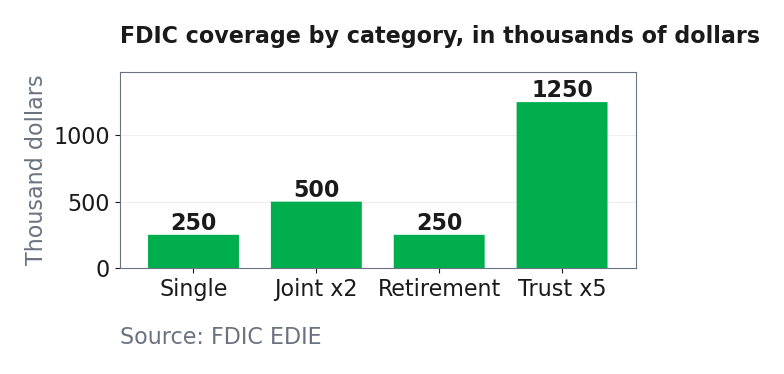
Read the chart with the same caution as the table. The trust bar is the maximum for five beneficiaries, not a promise for every trust. Beneficiaries must be eligible, the account title must match the trust arrangement, and the FDIC's records at the bank govern any actual claim. The chart is a map of the rule, not a substitute for checking your own accounts.
Two worked examples (illustrative arithmetic, not real accounts)
Example 1: one person, one category, too much in it. Suppose you hold a checking account with $200,000 and a savings account with $150,000, both in your name alone at the same bank. Added together, that is $350,000 in the single-account category.

Example 2: a couple, several categories, one bank. Suppose each spouse holds a single account covered up to $250,000, they share a joint account covered up to $500,000 ($250,000 per co-owner), and each holds a retirement account covered up to $250,000. Added together, that is $250,000 + $250,000 + $500,000 + $250,000 + $250,000 = $1,500,000 in total FDIC coverage at one bank — without opening an account at a second bank. The point is not that $1,500,000 is a target. The point is that the category structure, not the account count, is what creates the total. Each piece must genuinely meet its category's requirements; relabeling the same money does not create coverage.
A decision tree for your own accounts
Work through these questions in order. If you cannot answer one of them from your own account titles and statements, that is the answer: you need to check before you assume.
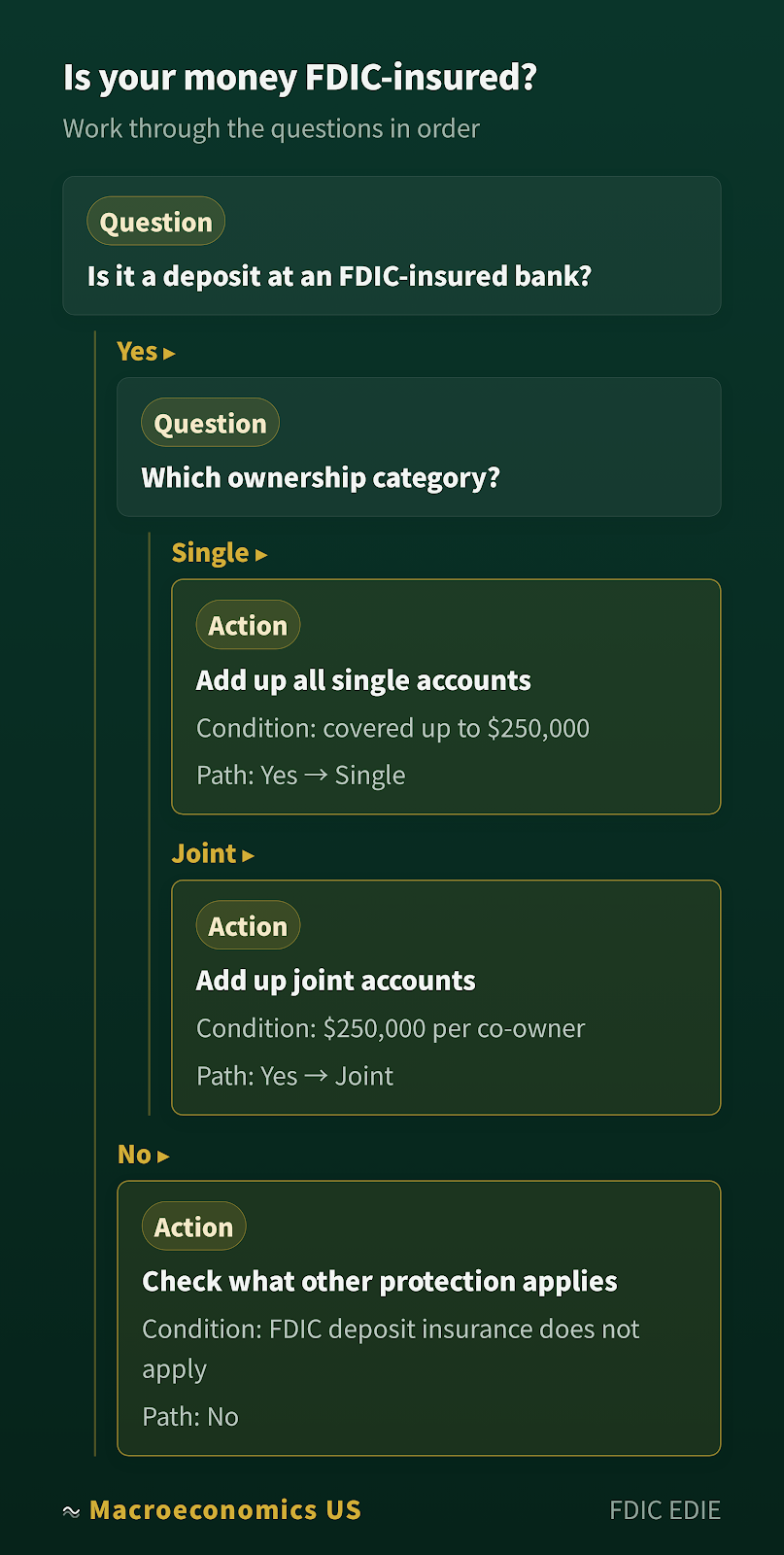
In text, the three questions are: (1) Is it a deposit at an FDIC-insured bank? (2) What ownership category is each account in? (3) Is any category total above its limit? If you cannot answer one from your own account titles and statements, check before you assume.
Two traps sit inside that tree. The first is the fintech trap: an app or a brand name on your account is not necessarily the bank that holds your deposit. If your money sits at a partner bank, it is that partner bank's category totals that matter, and money at two apps that use the same partner bank may be added together. The second is the branch trap: different branches of the same insured bank are not separately insured. A second branch does not create a second $250,000 bucket.
Your 10-minute check
Do this once, and repeat it whenever a large balance moves. First, confirm each institution is FDIC-insured, using the FDIC's BankFind tool, and note the exact legal bank name that holds each deposit — not just the brand on the app. Second, list every deposit account at each bank, grouped by ownership category, with the balance in each. Third, run those figures through the FDIC's Electronic Deposit Insurance Estimator (EDIE) for each bank, and save or print the result. Fourth, look specifically for the two most common surprises: several accounts in the same category adding up past $250,000, and a product you assumed was a deposit that is actually an investment product. If either shows up, fix the structure before you need the insurance, not after.
Credit unions are a separate system: they are insured through the National Credit Union Administration, not the FDIC. The standard amount is also $250,000 per depositor, per credit union, per ownership category, but you should check a credit union account in the NCUA's system, not in EDIE. Do not assume that a bank check and a credit union check are interchangeable.
Three more ways people get caught out
First, the partner-bank problem deserves a worked example of its own, because it is the newest version of an old mistake. Suppose you keep $200,000 in an account opened through one app and $100,000 in an account opened through a different app, and both apps actually hold your deposits at the same partner bank, in the same single-account category. Added together at that partner bank, that is $300,000 in one category — $50,000 above the $250,000 limit — even though you never opened two accounts at a bank with that name on the door. The brand on the screen is not the test. The legal bank holding the deposit is.
Second, do not confuse the number of products with the number of categories. A checking account, a savings account, a money market deposit account, and a certificate of deposit can all sit in the same single-account bucket if they are all in your name alone at the same bank. Opening a fourth product does not open a fourth bucket. What opens a new bucket is a genuinely different ownership arrangement that meets the FDIC's requirements for that category — a joint account with a co-owner, a retirement account, a qualifying trust, or a separate business entity, for example. If the arrangement exists only on paper to chase coverage, and not as a real ownership arrangement, do not count on it.
Third, remember that coverage is measured at the bank, not at the moment you feel safest. Balances move: interest accrues, a certificate matures into a checking account, a house sale lands in a savings account for a few weeks. A category that was under the limit in January can be over it in June without anyone opening a new account. That is why the 10-minute check is not a one-time exercise. Run it again after any large deposit, any account consolidation, and any change in how an account is titled. A title change — adding a co-owner, retitling into a trust, moving an account into a business name — can change the category, and therefore the coverage, in ways that are easy to get wrong and expensive to discover late.
If you are over the limit, what are the legitimate options
There are only a few honest moves, and all of them follow from the rule itself. Move some of the money to a different FDIC-insured bank, so that a new per-bank calculation applies. Restructure into a genuinely different ownership category, if the arrangement is real and the bank's records reflect it. Or ask your bank whether it participates in a deposit network that places excess funds at other insured banks, and if so, confirm in writing which banks hold your money and how much sits at each. What does not work is opening more accounts in the same category at the same bank, opening accounts at more branches of the same bank, or assuming that a product bought through a bank is automatically a deposit. Each of those leaves the category total exactly where it was.
The bottom line
The $250,000 number is not wrong. It is incomplete. What actually protects your money is the combination of the bank, the depositor, and the category — and the only way to know where you stand is to add up your own accounts the way the FDIC adds them up: by bank, by category, with interest included, and with investment products left out. Do that check once, and the headline number stops being a guess.
Sources
FDIC Electronic Deposit Insurance Estimator (EDIE), including the standard insurance amount of $250,000 per depositor, per insured bank, for each ownership category: FDIC EDIE calculator. FDIC EDIE guidance on trust coverage ($250,000 per beneficiary, up to $1,250,000 when five or more beneficiaries are named): FDIC EDIE information. Category figures in this post follow those FDIC sources; worked examples are arithmetic on the FDIC limits and on example balances labeled as examples in the text.
This post is general information, not personalized financial advice. For your own accounts, use the FDIC's estimator and, if the amounts are large or the structure is complex, confirm the arrangement with your bank.
Comments
Post a Comment