Social Security COLA 2027: 3.6% Is Official — Why Your Check Won't Rise by the $75 Average
The 2027 Social Security cost-of-living adjustment (COLA) is 3.6%, and the Social Security Administration (SSA) estimates it will lift the average retired-worker benefit from $2,095 to $2,170 a month, about $75 more (press release, October 14, 2026). That $75 is an average across many different benefits, so your own increase could land above or below it, and deductions can move your deposit by yet another amount. Your COLA notice shows your exact new benefit amount and deductions, and it can appear online up to three weeks before the paper copy if you have a my Social Security account and enroll in paperless notices by November 18, 2026.

The official numbers at a glance
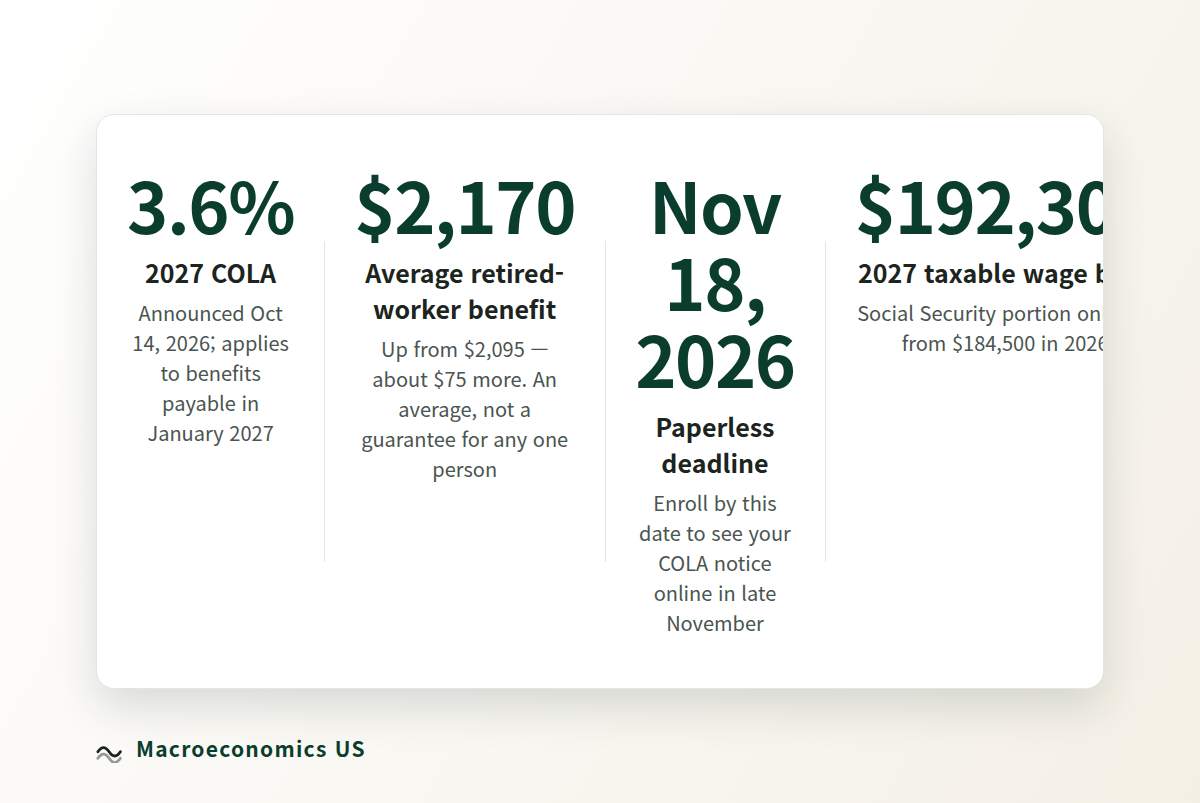
All figures in this article come from SSA's press release and its 2027 COLA fact sheet, as of the October 14, 2026 announcement.

| Item | Official value | What it means |
|---|---|---|
| 2027 COLA | 3.6% | Announced October 14, 2026. Applies to benefits payable in January 2027. |
| 2026 COLA | 2.8% | Last year's adjustment, shown for comparison. |
| Average retired-worker benefit | $2,095 → $2,170 | SSA's estimated average for January 2027, up about $75. An average, not a guarantee for any one person. |
Two numbers do different jobs here. The 3.6% is the rate applied to a gross benefit, and the $75 is SSA's estimated average dollar increase for retired workers. SSA reports nearly 72 million beneficiaries. Increased Supplemental Security Income (SSI) payments begin December 31, 2026.
One number is absent on purpose: the 2027 standard Part B premium had not been announced as of October 14, 2026, so this article does not estimate any net deposit.
When and where your own number appears
The COLA notice is a simplified, one-page document that shows your exact new benefit amount and your deductions. When you see it depends on how you get it.
- October 14, 2026: SSA announces the 3.6% COLA.
- November 18, 2026: Deadline to create a my Social Security account and enroll in paperless notices for online access.
- Late November: COLA notice online for account holders enrolled in paperless notices; 2027 Medicare premium visible in the Message Center for Medicare enrollees.
- December: Paper notices are mailed.
- December 31, 2026: Increased SSI payments begin.
- January 2027: Increased Social Security benefits are payable.
People with a my Social Security account who are enrolled in paperless notices can view the notice online starting in late November, up to three weeks before the paper notice. Anyone without an account needs to create one and enroll in paperless notices by November 18, 2026 to see it online. My read: if you already have an account but have not turned on paperless notices, enrolling by the same date is the safer plan.
Only one date in this timeline is a deadline for you: November 18, 2026. You can create or check your account at my Social Security today.
How SSA arrived at 3.6%
The Social Security Act ties the COLA to the CPI-W, a consumer price index published by the Bureau of Labor Statistics (BLS). SSA compares the average CPI-W for July through September 2026 with the average for July through September 2025, and 3.6% is the result. Because it is a quarterly-average comparison, the COLA is not September's headline inflation rate alone. The COLA is also never negative.
Why your increase differs from $75
Three things separate your number from the average: your benefit level, your deductions, and your benefit type. With nearly 72 million beneficiaries, no single dollar figure describes all of them.
Benefit level. The same 3.6% produces fewer dollars on a smaller benefit and more dollars on a larger one. Hypothetical inputs, not SSA figures: [ESTIMATE] $1,000 × 3.6% = +$36, and [ESTIMATE] $3,000 × 3.6% = +$108. Rule-of-thumb, not a forecast: [ESTIMATE] $75 ÷ 3.6% = $2,083, so a gross benefit near $2,083 rises by about $75, a smaller one by less, and a larger one by more.
Deductions. Your notice shows deductions next to your new benefit. The Medicare premium is the deduction this article covers, and it is one way a gross increase and a deposit increase can differ.
Benefit type. Even SSA's averages differ by type, as the table below shows.
| Household type | Before COLA | After COLA |
|---|---|---|
| All retired workers | $2,095 | $2,170 (+$75) |
| Aged couple, both receiving benefits | $3,238 | $3,355 (+$117) |
| All disabled workers | $1,642 | $1,701 (+$59) |
Reader math (hypothetical example; rule-of-thumb, not a forecast of your exact amount)
Formula, for any year's COLA: your current monthly benefit before deductions × the COLA percentage = your estimated increase. For 2027, the percentage is 3.6%.
Percent math: your gross benefit rises by 3.6%.
Dollar math (hypothetical): a $2,000 monthly benefit × 3.6% = +$72, which gives $2,072 before deductions. The $2,000 is an illustration input, not an SSA figure.
Your notice shows your exact amount. This box does not estimate your net deposit.
The Medicare offset: gross, deductions and net
The chain from headline to deposit has five links: CPI-W quarterly-average comparison → 3.6% COLA → your gross benefit (hypothetical: $2,000 → $2,072) → deductions, including the Medicare Part B premium (no 2027 figure announced as of October 14, 2026) → net deposit (not estimated here). Three amounts are in play:
- Gross benefit: your benefit after the COLA, before anything is taken out. The COLA raises this number.
- Deductions: amounts taken out of your benefit, including the Medicare Part B premium when it is deducted from your benefit.
- Net deposit: what reaches your account, equal to gross benefit minus deductions.
That absent premium figure is why this section offers a formula and an action instead of a net-deposit number. SSA says 2027 Medicare changes will be posted at medicare.gov, and for Medicare enrollees the 2027 premium amount will be available in the my Social Security Message Center starting in late November.
One rule, called hold harmless, can limit how much a higher premium cuts into your deposit. For most beneficiaries whose Part B premium is deducted from their benefit, hold harmless generally prevents the standard premium increase from reducing their net Social Security payment. It has eligibility conditions and exceptions, and it does not cover every Medicare cost. It is also not a promise that your deposit rises by the full 3.6%.
Your action: open the Message Center in late November, read your exact 2027 premium amount, and compare it with the deductions on your COLA notice. My read: until you have both in front of you, any net-deposit number is a guess.
Two side doors: taxes and the earnings test
### Taxes
A larger benefit can change how much of your benefit is taxable. It does not automatically make your benefits taxable. My read: when you plan 2027 taxes, use the amount on your notice rather than the $75 average, and ask a tax professional how it applies to you.
### The earnings test, for readers still working
If you collect benefits before full retirement age and keep working, the retirement earnings test can withhold part of your benefit. SSA's 2027 limits, as of October 14, 2026:
- Under full retirement age all year: the limit is $25,560 a year, and $1 is withheld for every $2 above it.
- Reaching full retirement age in 2027: the limit is $67,920 a year for earnings before the month you reach it, and $1 is withheld for every $3 above it.
- From the month you reach full retirement age: no earnings test.
The test applies to wages and self-employment earnings, not all income. Benefits withheld are credited back at full retirement age.
Rule-of-thumb, not a forecast: benefits withheld in a year ≈ earnings above your limit ÷ 2 if you are under full retirement age all year, or ÷ 3 in the year you reach it. Percent math: [ESTIMATE] $1 ÷ $2 = 50% and $1 ÷ $3 ≈ 33% of each dollar above the limit. Hypothetical [ESTIMATE]: $35,560 in earnings while under full retirement age all year is $10,000 above the limit ($35,560 minus $25,560), so about $5,000 is withheld ($10,000 ÷ 2). The $35,560 is an illustration input, not an SSA figure.
Not to be confused with the earnings test: the 2027 taxable wage base, for the Social Security portion only, is $192,300, up from $184,500 in 2026 (as of October 14, 2026).
At a glance: what can change your number
| Item | Possible effect | Your action |
|---|---|---|
| COLA | Raises your gross benefit by 3.6% of your current amount before deductions. Your deposit can differ. | Open your COLA notice and read the exact new benefit amount. |
| Part B premium | A premium deducted from your benefit can make your net change differ from your gross change. Hold harmless generally prevents the standard premium increase from reducing the net payment for most beneficiaries, with conditions and exceptions. | Check your 2027 premium in the Message Center starting in late November. |
| Taxation | A larger benefit can change how much of your benefit is taxable. It does not automatically make benefits taxable. | Plan with your notice amount and ask a tax professional how it applies to you. |
| Earnings test | If you work before full retirement age, benefits can be withheld above the 2027 limits ($25,560 or $67,920). | Compare your expected 2027 earnings with the limit that applies to you. |
Why a bigger check is not a raise
A COLA offsets measured inflation. The dollars on your check (nominal) go up, but what matters is what those dollars buy (real). Hypothetical: if your monthly costs are $2,000 and they also rise 3.6%, they go up by $72, which equals the $72 COLA in the reader-math box. In that case the check is bigger and the buying power is unchanged. If your costs rise faster than 3.6%, the check buys less; if slower, it buys a little more.
My read: treat the COLA as an attempt to hold your buying power steady, not as extra spending money. It compares two past quarters, so it measures price changes that already happened, and your own costs could rise faster or slower than the CPI-W.
The $75 is SSA's average. Your notice is your number, so put November 18, 2026 on your calendar and have your account set up when it appears online in late November.
- Create or verify your my Social Security account. You need one to see the notice online.
- Enroll in paperless notices by November 18, 2026. If you do not have an account, create one first.
- Open your COLA notice in late November. It is available online then for enrolled account holders, and paper notices are mailed in December.
- Compare gross benefit with deductions. Net deposit equals gross benefit minus deductions, so read both lines.
- Check your Part B amount in the Message Center. For Medicare enrollees, the 2027 premium amount is available there starting in late November.
- Update your January budget with the real number. Use the figure from your own notice and premium amount, not the $75 average, and compare it with your January payment when it arrives.
Sources and links, as of the October 14, 2026 announcement: SSA press release, SSA 2027 COLA Fact Sheet, SSA COLA hub and my Social Security.

Comments
Post a Comment