Medicare Open Enrollment 2026: 6 Things to Check Before December 7

Medicare Open Enrollment 2026: 6 Things to Check Before December 7
By Daniel Kim | Information as of Oct 15, 2026
If you like your Medicare plan and expect to do nothing this fall, keeping the same plan is not the same as keeping the same benefits. Your plan may change its premiums, benefits, networks, or drug coverage for the new year, and the annual window to act closes Dec 7, 2026.
Below are six checks to run before you decide to stay or switch. This is general information, not a recommendation of any specific plan.
The dates and what this window allows
Annual Open Enrollment (AEP) runs from Oct 15, 2026 through Dec 7, 2026 (Medicare.gov Open Enrollment).
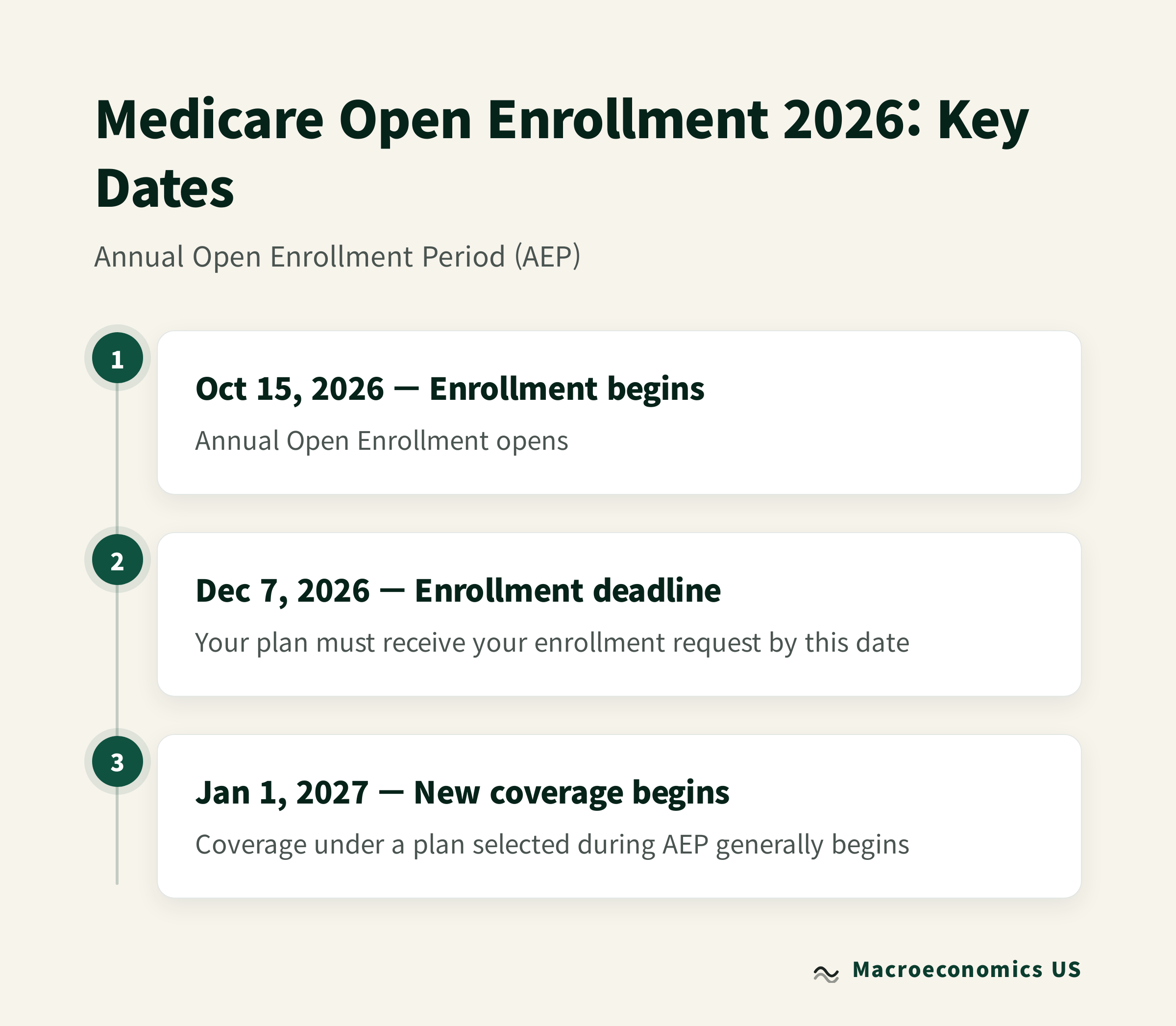
| Date | What happens |
|---|---|
| Oct 15, 2026 | AEP begins |
| Dec 7, 2026 | Your plan has to receive your enrollment request by this date for the usual annual change |
| Jan 1, 2027 | Coverage under a plan selected during AEP generally begins, and changes to a plan you keep can also take effect |
During AEP you can generally:
- Switch between Original Medicare and Medicare Advantage
- Switch Medicare Advantage plans
- Join, drop, or switch a standalone Part D prescription drug plan, when you are eligible for that option
AEP is not the Medicare Advantage Open Enrollment Period (January through March), and other enrollment rights can apply in specific circumstances. Dec 7 is the usual deadline for this annual change, not the only one in every Medicare situation.
Check 1: Read your Annual Notice of Change
The Annual Notice of Change (ANOC) is the notice existing plan members receive in the fall describing changes scheduled for next year. Plans are generally required to send the ANOC and the Evidence of Coverage so current enrollees receive them by Sept 30. That is a receipt-by date, not a prepare-by date, and as of Oct 15, 2026 it has passed. Certain dual-eligible special needs plans (D-SNPs) may send the ANOC by Sept 30 and the Evidence of Coverage by Dec 31 under applicable conditions, so Sept 30 is not a universal deadline.
Compare your current plan with next year's on five points:
- Monthly plan premium
- Deductibles and copayments
- Covered services and benefits
- Prescription coverage and cost-sharing
- Provider networks and service areas
If you cannot find your notice, contact the plan instead of assuming the terms are unchanged. A missing notice does not prove your benefits stayed the same (see Medicare.gov Annual Notice of Change).
Check 2: Price the whole year, not just the premium
For each plan you consider, find these items in its 2027 documents or in Medicare Plan Compare:
| Cost item | What to find |
|---|---|
| Monthly premium | The 2027 amount, compared with what you pay now |
| Deductible | The 2027 amount, if any |
| Copayments and coinsurance | Your cost for the services you use |
| Out-of-pocket limit | Whether one applies to covered Part A and Part B services, and the 2027 amount |
| Prescription expenses | Tiers, restrictions, and pharmacy arrangements |
Original Medicare generally has no annual out-of-pocket limit for Part A and Part B services unless you have supplemental coverage or another applicable protection, while Medicare Advantage plans have an annual limit for covered Part A and Part B services (see Medicare.gov Compare Original Medicare and Medicare Advantage). Any actual 2027 premium, deductible, or limit has to come from your specific plan's 2027 documents or Plan Compare results, because a generic figure does not apply to every beneficiary (see Medicare.gov Medicare costs).
Reader math (rule-of-thumb, not a forecast):
Estimated yearly cost = (monthly premium × 12) + deductible + copayments and coinsurance you expect to pay + prescription costs
Run it for each option, adding a line for any separate piece you would need, such as a Medigap policy or a standalone Part D plan. My read: the out-of-pocket limit applies to covered Part A and Part B services, so it may not cap every line above. Ask the plan what counts toward it.
One number shows why the 2027 documents matter. As of Oct 15, 2026, the maximum permitted Part D deductible is $700 for 2027, compared with $615 for 2026, according to Medicare.gov Part D costs. How that maximum reaches your wallet:
- Event: the maximum moved from $615 to $700. Dollar math: $85 ($700 minus $615). Percent math: about 13.8% ($85 divided by $615).
- Transmission: a plan may charge up to $700. Some charge less, and some have no deductible ($0).
- Wallet impact: your deductible could fall anywhere from $0 to $700. Check your plan's 2027 documents instead of assuming it rose by $85.

Check 3: Match your prescriptions to the 2027 formulary
A formulary is the list of prescription drugs a plan covers. Build your list, then test it against each plan you are considering:
- Write down each drug name, its dosage, and the pharmacy you use now.
- Check each drug against the proposed plan's 2027 formulary for coverage and cost-sharing tier.
- Note any prior authorization or other restrictions.
- Check any preferred pharmacy arrangement against the pharmacy you use.
Do not assume a drug is covered, or costs less, until you have checked the exact plan, the 2027 coverage year, and the restrictions (see Medicare.gov What drug plans cover).

Check 4: Confirm your doctors and hospitals for the exact plan
With Medicare Advantage, confirm that your important providers participate in the specific plan and network for 2027: primary care, specialists, hospitals, and facilities. Confirm with both the plan and the provider's office, especially if your treatment is ongoing.
With Original Medicare, you can generally use Medicare-participating providers nationwide, subject to Medicare coverage rules and provider acceptance.
Treat a provider directory as a starting point, not a guarantee of future participation. Directories can change or be inaccurate.
Check 5: Know what changes before you switch coverage types
Original Medicare is federal coverage under Parts A and B, and you generally use providers who accept Medicare. Medicare Advantage is Medicare-approved private-plan coverage that typically combines Part A and Part B and may include Part D. Networks, referrals, and prior authorization can matter.
Before moving from Medicare Advantage to Original Medicare, investigate:
- Whether you need a separate Part D plan
- Whether you want Medigap supplemental insurance
- Whether you can obtain Medigap under the rules and timeline that apply
- Whether your treatment, supplemental benefits, or provider arrangements would be affected
As of Oct 15, 2026, item 3 depends on your situation and your state. Here is the federal rule beside one state's rule:
| Topic | Federal rule, generally | New York example only |
|---|---|---|
| Protected purchase window | A 6-month Medigap Open Enrollment Period when you are at least 65 and enrolled in Part B, beginning the first day of the month both conditions are met | New York State Department of Financial Services states that New York law requires insurers writing Medigap to accept Medicare enrollees' applications throughout the year |
| Outside that window | An insurer may generally use medical underwriting or deny an application, unless a guaranteed-issue right or other protection applies | Insurers may not deny or make premium-rate distinctions because of health status, claims experience, medical condition, or whether the applicant is receiving care |
| Special situations | When a guaranteed-issue right applies, the window and policies depend on the qualifying event. For certain qualifying coverage losses, Medicare.gov describes a window from 60 days before to 63 days after, which is not a universal deadline for every purchase or switch | Protections also apply to beneficiaries eligible due to disability or end-stage renal disease, subject to applicable state rules and eligibility |
The New York column is an example, not a nationwide rule, and other states differ. Do not assume you can buy Medigap at any time on the same terms, or that moving to Original Medicare automatically solves an access or cost concern. Start with Medicare.gov Get ready to buy Medigap, Medicare.gov When can I buy Medigap, and Medicare.gov Switching or dropping Medigap. For New York, read the New York DFS Medicare beneficiary information.
Check 6: Protect yourself from enrollment scams
Be cautious with unsolicited requests for your Medicare number or other sensitive information, and do not rush a decision because a caller claims your benefits will disappear immediately. Verify through official Medicare channels. Do not share these with an unsolicited caller or message:
- Medicare numbers and card details
- Social Security numbers
- Banking and credit-card details
- Other sensitive personal information, especially under pressure
Plans do not need your personal information merely to give you a quote. Still, not every unsolicited contact is fraudulent, and legitimate enrollment sometimes requires personal information. Before you share anything, confirm three things: you verified who you are dealing with, the information is necessary for that step, and you authorized the transaction.
| Situation | Where to go |
|---|---|
| Questionable Medicare charges, or general assistance | Medicare.gov or 1-800-MEDICARE (1-800-633-4227) |
| Suspected Medicare fraud, fraudulent claims, or medical identity theft | HHS-OIG Report Fraud, or the HHS-OIG Hotline at 1-800-HHS-TIPS (1-800-447-8477) |
| Suspected fraud by a plan or agent | Call 1-800-MEDICARE. Suspected criminal or fraudulent activity may also go to HHS-OIG |
What Medicare Plan Compare can and cannot tell you
Medicare Plan Compare is the official tool for comparing premiums, costs, benefits, and coverage. As of Oct 15, 2026, CMS states that Medicare Plan Finder was to be updated with 2027 health and drug plan information by Oct 1, 2026. 2027 Star Ratings appeared in Plan Finder on Oct 8, 2026, ahead of enrollment starting Oct 15.
A comparison result does not guarantee that:
- Your provider stays in-network all year
- Your prescription is covered in every circumstance
- The displayed cost equals your final annual spending
- A plan is the best choice for all beneficiaries
- You qualify for every listed option or subsidy
Verify the details that matter against the plan's 2027 Evidence of Coverage, formulary, provider directory, and eligibility requirements.
If you do nothing
In general, if you keep your existing Medicare health and drug coverage, you do not have to submit a new enrollment request just to stay enrolled. Your coverage generally continues, but scheduled changes to premiums, benefits, networks, or drug coverage may take effect for the new year. Inaction does not automatically mean your coverage disappears on Dec 7. Plan discontinuation, service-area changes, or other circumstances can call for a separate review of the notices you receive.
Your save-worthy checklist
- Read your Annual Notice of Change.
- Compare 2027 premiums and cost-sharing.
- Check every prescription against the 2027 formulary.
- Verify doctors, hospitals, and pharmacies.
- Investigate Medigap and separate drug coverage before changing coverage types.
- Use official resources, and verify suspicious requests.
- If you are changing coverage, confirm the plan receives your enrollment request by Dec 7, 2026.
Staying is still a choice, and your Annual Notice of Change describes the changes scheduled for 2027. Open it today, or call your plan if you cannot find it.
About the author: Daniel Kim
Daniel Kim writes about practical knowledge for everyday life and your wallet — from household money decisions to understanding the economy around you.
Comments
Post a Comment