Lump Sum Cash: How $10,000 Can Lose Value If It Just Sits
You just received $10,000 you did not expect: a bonus, a tax refund, a small windfall. The bottom line is simple, and it comes before any product name. Put money you owe soon in checking, pay down your highest-APR debt, keep a buffer you can reach any day, and only then lock money away for yield. The order matters more than the exact split, because each step protects the next one.
Here is the key figure. At the national average savings rate of 0.38% (FDIC, October 19, 2026), $10,000 earns $38 in a year. At the current Series I savings bond composite rate of 4.26% (TreasuryDirect, for bonds issued May 1 to October 31, 2026), the same $10,000 earns $426 in a year if the rate holds steady. The gap is $388, before taxes, on the same sum. Leaving the whole amount in an average account does not feel like a decision, but the arithmetic treats it as one.
This post uses $10,000 as the worked example throughout, because the FDIC publishes its national averages on deposit tiers that include $10,000. If your sum is different, the order below stays the same and the dollar figures scale with it.
Why sitting cash quietly costs you
The Federal Reserve held its target range at 3.75% to 4.00% on October 28, 2026, by a 10–2 vote, with two members preferring a quarter-point increase instead (Federal Reserve). The same statement said inflation remains elevated and that the Committee aims to return inflation to its 2% goal. Those two facts frame the whole problem: the policy rate sits near 4%, yet the average saver earns a small fraction of it.
The FDIC's national average rates, published October 19, 2026, show how wide that gap runs in practice (FDIC). The average savings account pays 0.38%. The average money market deposit account pays 0.63%. The average 12-month certificate of deposit (CD) pays 1.76%. Interest checking averages 0.07%, which turns $10,000 into $7 of interest in a year. None of these averages is a promise about your bank: your bank sets its own rate, and many banks pay well above the average. The average is useful as a yardstick. If your account pays less than the average for its type, you are on the wrong side of an already wide gap.
Run the one-year illustration on $10,000, with rates held steady and before taxes, using simple interest so every reader can check the math:
- Average savings at 0.38%: $10,000 × 0.0038 = $38
- Average money market deposit account at 0.63%: $10,000 × 0.0063 = $63
- Average 12-month CD at 1.76%: $10,000 × 0.0176 = $176
- Series I bond at 4.26%: $10,000 × 0.0426 = $426
The lesson is not that one product wins for everyone. It is that the default — money sitting wherever it landed — usually earns the lowest row, and the difference compounds year after year.
The order: bills, debt, buffer, then yield
Work through these steps in order, and stop at the step where your money runs out. Do not skip ahead to yield while an earlier step is unpaid.
Money you owe soon stays liquid. Rent, a tax bill, an insurance premium, or any bill due in the next 60 days belongs in checking or an account you can reach the same day. Chasing yield with money that has a due date attached is how a small shortfall turns into a late fee or a missed payment. No rate in this post is worth that trade.
High-interest debt comes before investing. Find the annual percentage rate (APR) printed on your card statement. Paying down a balance at that APR gives you a return equal to the interest you stop paying, with no market risk attached. That is why debt outranks every deposit product in the table below: no savings account or bond in this post pays an APR as high as a typical card charges, and the saving starts the day you pay. If you carry balances on more than one card, clear the highest APR first, then move down the list. If your only debt is a low-rate mortgage or student loan with no late-payment risk, that is a different judgment, and it belongs after the buffer step, not before it.
The buffer stays reachable any day. This is money for the expense you cannot date: a car repair, a medical bill, a sudden gap between paychecks. It belongs in an insured savings or money market deposit account, not in anything with a lock. The test is practical: can you reach it tomorrow without a penalty and without asking anyone's permission? If the answer is no, it is not buffer money.
Only the remainder chases yield. Money you will not need for at least 12 months can go into a CD or a Series I bond, where the lock buys a higher rate. Money you might need sooner stays out, even if the rate looks tempting. The lock is the price of the yield, and the rest of this post prices it exactly.
One workable illustration for a $10,000 sum with no urgent bills and one high-APR card: $3,000 to the card, $4,000 to an insured savings buffer, $3,000 to a Series I bond. Change the amounts to fit your bills and your debt. Keep the order.
The comparison table
| Option | Rate (October 2026) | Lock and access | Insurance and risk |
|---|---|---|---|
| Average savings account | 0.38% national average (FDIC) | No lock; any day | FDIC-insured to $250,000 per depositor, per bank, per ownership category; rate can move at any time |
| Money market deposit account | 0.63% national average (FDIC) | No lock; any day, often with checks or a debit card | FDIC-insured on the same terms; rate can move at any time |
| 12-month CD | 1.76% national average (FDIC) | Rate fixed for 12 months; leaving early usually triggers a penalty | FDIC-insured on the same terms; rate fixed for the term |
| Series I savings bond | 4.26% composite (TreasuryDirect, bonds issued May 1–October 31, 2026) | Cannot cash for 12 months; cashing before 5 years costs the last 3 months of interest | Backed by the full faith and credit of the U.S. government; rate resets every 6 months; $10,000 purchase cap per person per year |
| Pay down high-interest debt | Your card's APR, read off your statement | Immediate: interest stops on the amount repaid | No market risk; the return is interest you no longer pay |
Two distinctions in that table deserve emphasis. A money market deposit account is a bank deposit, and it is insured. A money market fund is a mutual fund, and the FDIC lists mutual funds among the products it does not insure. Similar names, different products, different protection. Check which one you hold before you count on coverage.
Series I bonds, in plain terms
The 4.26% composite rate has two parts (TreasuryDirect). The fixed rate is 0.90%, and it stays with your bond for its life. The semiannual inflation rate is 1.67%, and it resets every 6 months from your bond's issue date. The composite formula is: fixed rate + (2 × semiannual inflation rate) + (fixed rate × semiannual inflation rate). Plug in the current numbers: 0.0090 + (2 × 0.0167) + (0.0090 × 0.0167) = 0.0426, or 4.26%. The composite rate can go up or down when the inflation part resets, and it never falls below 0%. Interest compounds semiannually.
The rules around the rate matter as much as the rate itself (TreasuryDirect):
- Minimum purchase: $25.
- Maximum purchase: $10,000 per person per calendar year in electronic bonds.
- You cannot cash a bond during its first 12 months, for any reason. Money you might need within a year does not belong here.
- If you cash before 5 years, you lose the last 3 months of interest. On the simple-interest illustration, cashing $10,000 at month 12 returns about $320 instead of $426: $426 minus 3 months of interest ($10,000 × 4.26% ÷ 4 = $106.50) equals $319.50.
- Bonds earn interest for up to 30 years.
That 12-month lock is the reason I bonds sit last in the order above, behind bills, debt, and buffer. The rate is the highest in the table, and the lock is the strictest. Both facts belong in the same sentence whenever you weigh this option.
What FDIC insurance does and does not cover
Deposits at FDIC-insured banks are insured to $250,000 per depositor, per insured bank, for each account ownership category (FDIC). The limit applies per bank and per category, not per account: two savings accounts at the same bank in the same ownership category share one $250,000 limit. If your lump sum pushes you near that limit at one bank, split it across banks or ownership categories rather than assuming each account gets its own limit.
Covered products include checking accounts, savings accounts, money market deposit accounts, and CDs. Products the FDIC does not insure include stocks, bonds, mutual funds, crypto assets, life insurance policies, annuities, municipal securities, and the contents of a safe deposit box. U.S. Treasury bills, notes, and bonds are also not FDIC-insured; they are backed by the full faith and credit of the U.S. government instead, which is a different form of backing. For a moderate lump sum, the practical check is short: confirm your bank is FDIC-insured, confirm your total at that bank in each ownership category sits under $250,000, and confirm that anything labeled a fund is not being counted as a deposit.
The tax line you should not forget
Interest you receive, or that is credited to an account you can withdraw from without penalty, is taxable income in the year it becomes available to you (IRS). If you receive $10 or more of interest, you should receive Form 1099-INT. You must report all taxable interest on your federal return even if no form arrives, including amounts under $10. Every dollar figure in this post is before taxes, so the after-tax result will be smaller by your tax rate.
Two details soften that line for Treasury products. Interest on Treasury bills, notes, and bonds is subject to federal income tax but exempt from all state and local income taxes (IRS). Interest on Series EE and Series I savings bonds is generally not included in income until the earlier of maturity or redemption, so the tax on I bond interest can wait until you cash out, unless you elect to report it each year (IRS). There is also an exclusion for I bond interest used for qualified higher education expenses, subject to its own requirements (IRS). None of this is tax advice for your situation; it is the reason to set aside part of any interest you earn rather than spending the full pre-tax figure.
The chart
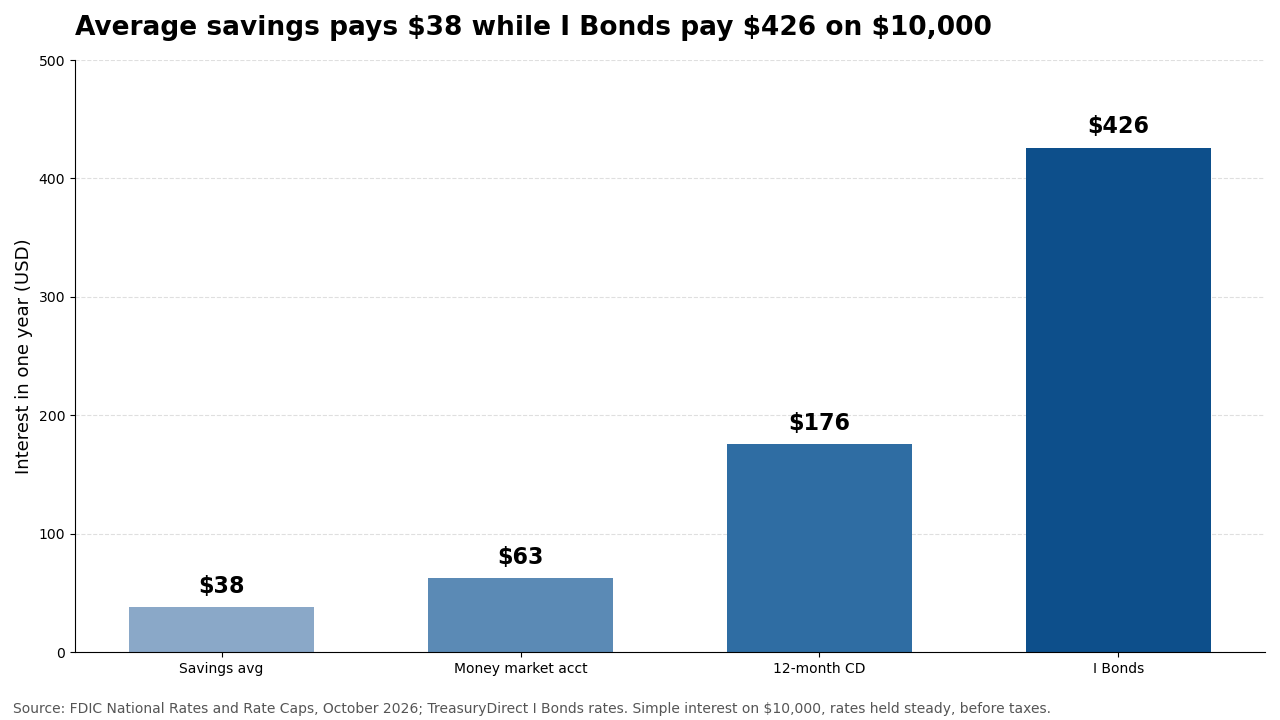
Read the chart with its assumptions attached. Each bar is the interest on $10,000 held for one year, computed with simple interest, with rates held steady, before taxes. The savings, money market, and CD bars use the FDIC national averages of October 19, 2026. The I bond bar uses the 4.26% composite rate for bonds issued May 1 to October 31, 2026, and assumes that composite holds for the full year. In practice the inflation part resets every 6 months, so the real I bond figure will differ, and cashing at month 12 hands back 3 months of interest, about $320 net on this illustration. The chart shows the size of the gap, not a promise about any single account.
Save this: the lump-sum checklist
- Bills due in the next 60 days: covered, sitting in checking.
- Highest-APR debt: identified from your statement, payoff planned before any investing.
- Buffer: reachable any day, in an insured account, with no penalty for withdrawal.
- Locked money: only cash you will not need for 12 months, in a CD or I bond.
- Insurance check: deposits under $250,000 per bank per ownership category; funds not counted as deposits.
- Rate check: your account's APY compared with the FDIC national average for the same account type.
- Tax note: expect Form 1099-INT for $10 or more of interest, and set aside for tax on the interest you earn.
FAQ
What if my lump sum is $2,000, not $10,000?
The order does not change; only the amounts shrink. Bills first, highest-APR debt second, reachable buffer third, locked yield last. Every dollar of high-APR debt repaid saves the same APR, whatever the total.
Can I buy more than $10,000 in I bonds in a year?
No. TreasuryDirect caps electronic I bond purchases at $10,000 per person per calendar year. If your sum is larger than that, the excess needs a different home from the table above.
What happens if I need I bond money before 12 months?
You cannot cash it at all during the first 12 months. That hard lock is why money you might need within a year stays in the buffer step, even when the I bond rate is the highest number in this post.
Is a money market fund FDIC-insured?
No. A money market fund is a mutual fund, and the FDIC lists mutual funds among the products it does not insure. A money market deposit account at an insured bank is a different product, and it is insured. Check the product type, not just the name.
Does the Fed's rate decide what my bank pays?
No. The Federal Reserve sets a target range for the federal funds rate — 3.75% to 4.00% after the October 28, 2026 decision — and each bank sets its own deposit rates. The gap between that range and the 0.38% average savings rate is exactly why shopping for a rate matters: you cannot earn the Fed's rate directly; you earn whatever your bank offers.
Do I owe tax on the interest?
Yes, in the year it becomes available to you, and you must report it even if no Form 1099-INT arrives. Treasury interest is exempt from state and local income taxes, and savings bond interest is generally deferred until you redeem. Set aside for the tax rather than spending the pre-tax figure.
Sources
- [S1] TreasuryDirect, I Bonds interest rates — composite rate 4.26%, fixed rate 0.90%, semiannual inflation rate 1.67%, bonds issued May 1 to October 31, 2026: <https://treasurydirect.gov/savings-bonds/i-bonds/i-bonds-interest-rates/>
- [S2] FDIC, National Rates and Rate Caps, October 2026 — national averages as of October 19, 2026: savings 0.38%, money market 0.63%, 12-month CD 1.76%, interest checking 0.07%: <https://www.fdic.gov/national-rates-and-rate-caps>
- [S3] FDIC, Deposit Insurance At A Glance — $250,000 per depositor, per insured bank, per ownership category; covered and non-covered products: <https://www.fdic.gov/resources/deposit-insurance/brochures/deposits-at-a-glance>
- [S4] Federal Reserve, FOMC statement, October 28, 2026 — target range held at 3-3/4 to 4 percent, 10–2 vote, dissenters Cook and Hammack: <https://www.federalreserve.gov/newsevents/pressreleases/monetary20261028a.htm>
- [S5] IRS, Topic No. 403, Interest received — interest taxable in the year available; Form 1099-INT at $10 or more; Treasury interest state/local exempt; savings bond deferral: <https://www.irs.gov/taxtopics/tc403>
Comments
Post a Comment