How to Compare Mortgage Rates in 2026 — What Actually Saves You Money

The Rate You Saw Online Is Not the Rate You Were Offered
You find a mortgage lender advertising a 6.5% mortgage rate. It looks promising, so you fill out the application. A loan officer reviews your information and sends you a quote at 7.2%.
What happened?
You did not necessarily get a bad deal, and the lender may not have changed its advertised offer. The original rate might have assumed an excellent credit profile, a specific down payment, a particular loan type, and discount points paid at closing. Your actual quote may be based on different assumptions.
This is why comparing mortgage rates in 2026 requires more than searching for the lowest percentage online. The real question is how much the loan will cost you upfront, each month, and over the period you expect to keep it.
Mortgage rates also change with financial market conditions. Freddie Mac publishes a weekly survey of average mortgage rates, which is useful for understanding the broader market. However, its national averages are benchmarks, not personalized offers.
Source: Freddie Mac Primary Mortgage Market Survey — https://www.freddiemac.com/pmms
A mortgage rate that looks slightly higher can sometimes be the better deal if it comes with lower fees. Conversely, a low advertised rate can become expensive when you include discount points, origination charges, or other costs.
Here is how to separate a genuinely competitive mortgage offer from one that only looks attractive.
1. Why Advertised Mortgage Rates Differ From Your Actual Rate
Mortgage lenders do not offer every borrower the same price. Several factors influence the rate you receive.
Your credit score matters
Lenders assess the risk associated with lending you money. Your credit history, credit score, debt obligations, and other financial details can affect both your eligibility and the pricing you receive.
For conventional mortgages, credit scores and other loan characteristics can affect pricing. A borrower with a strong credit profile may qualify for a more competitive rate than someone with a weaker profile, even when both are purchasing similar homes.
Do not assume that a particular credit score automatically guarantees a specific rate. The impact depends on the loan program, down payment, property, and lender.
Before applying, review your credit reports and address errors you find. Avoid making unnecessary financial changes while preparing for a mortgage, and ask prospective lenders how your credit profile affects their pricing.
Useful resources:
- AnnualCreditReport.com: https://www.annualcreditreport.com/
- Consumer Financial Protection Bureau, mortgage rate comparisons: https://www.consumerfinance.gov/owning-a-home/explore-rates/
The CFPB's mortgage rate tool allows you to explore how factors such as credit score, down payment, loan type, and loan term can affect estimated rates and costs.
Your loan type changes the comparison
A conventional mortgage, FHA loan, VA loan, and USDA loan do not necessarily have the same pricing structure.
For example, a borrower who qualifies for a VA-backed mortgage should not automatically compare its advertised rate with a conventional mortgage and assume the lower percentage represents the better deal. Eligibility requirements, mortgage insurance or funding fees, down payment requirements, and other costs can differ.
The same issue arises when comparing a fixed-rate mortgage with an adjustable-rate mortgage, commonly called an ARM.
A fixed-rate mortgage generally keeps its contractual interest rate unchanged throughout the fixed term. An ARM may begin with a lower initial rate but can adjust later according to its terms. The initial payment alone does not tell you how expensive the adjustable loan could become.
Compare the same type of loan, the same term, and the same down payment before deciding which lender is cheaper.
Sources:
- CFPB mortgage shopping guide: https://www.consumerfinance.gov/consumer-tools/mortgages/shopping-for-a-mortgage/
- U.S. Department of Veterans Affairs home loans: https://www.va.gov/housing-assistance/home-loans/
- HUD FHA mortgage information: https://www.hud.gov/helping-americans/fha-loans
Discount points can make the advertised rate misleading
Some lenders advertise a low rate that assumes you will pay discount points.
A discount point is an upfront charge paid in exchange for a lower interest rate. One point generally equals 1% of the loan amount.
On a $300,000 mortgage, one discount point would cost $3,000. That is money you pay upfront, usually as part of closing costs, to obtain the agreed rate reduction.
The key question is whether the monthly savings justify that upfront expense.
Suppose one lender offers a loan with no discount points, while another advertises a lower rate that requires you to pay points. You need both offers' actual interest rates, fees, and monthly payments to calculate which is better.
Ask each lender to provide pricing with zero points and with any proposed points clearly itemized.
Sources:
- CFPB explanation of discount points and lender credits: https://www.consumerfinance.gov/ask-cfpb/how-should-i-use-lender-credits-and-points-also-called-discount-points-en-136/
- CFPB guide to comparing Loan Estimates: https://www.consumerfinance.gov/owning-a-home/compare/compare-loan-estimates/
2. Interest Rate vs. APR: Which Number Should You Compare?
One of the most common mortgage-shopping mistakes is treating the interest rate and the annual percentage rate, or APR, as interchangeable.
They are related, but they measure different things.
The interest rate determines how interest accrues on your outstanding mortgage principal.
The APR expresses the annualized cost of borrowing, incorporating the interest rate and certain loan charges. It is designed to help consumers compare credit offers with different rates and fees.
APR can include certain charges associated with obtaining the loan, but it does not necessarily include every cost of homeownership. Property taxes, homeowners insurance, maintenance, and every possible closing expense are not automatically captured in the APR.
A lower APR can indicate a less expensive loan under comparable assumptions, but you should not select a mortgage by APR alone.
Consider two hypothetical offers for the same borrower:
- Offer A: A lower interest rate with substantial discount points paid upfront.
- Offer B: A slightly higher interest rate with fewer upfront charges.
Offer A may have a lower monthly principal-and-interest payment, while Offer B may require less cash at closing. Which one saves you money depends partly on how long you keep the loan.
If you sell the home or refinance before recovering the cost of the points, paying extra upfront may not have been worthwhile.
Use the Loan Estimate, not just an online calculator
When you apply for a mortgage, the lender provides a standardized document called a Loan Estimate. It summarizes the proposed rate, monthly payment, closing costs, and other important loan terms.
Compare the same sections across lenders.
Pay particular attention to:
- The interest rate and whether it is fixed or adjustable.
- The estimated principal-and-interest payment.
- Origination charges and discount points.
- Lender credits.
- Estimated cash needed at closing.
- The loan's five-year cost comparison.
The CFPB explains how to use the Loan Estimate's five-year comparison. On the form, the "In 5 years" figure includes principal and interest paid over that period, while the principal-paid figure shows how much of the loan balance you have repaid. Subtracting the principal-paid figure from the first amount gives an estimate of interest and fees paid during those five years.
This is especially useful if you expect to move or refinance before the mortgage reaches its full term.
Source: https://www.consumerfinance.gov/owning-a-home/compare/compare-loan-estimates/
3. What a Small Rate Difference Can Cost You
A difference that looks minor on a website can become substantial when applied to a large loan over many years.
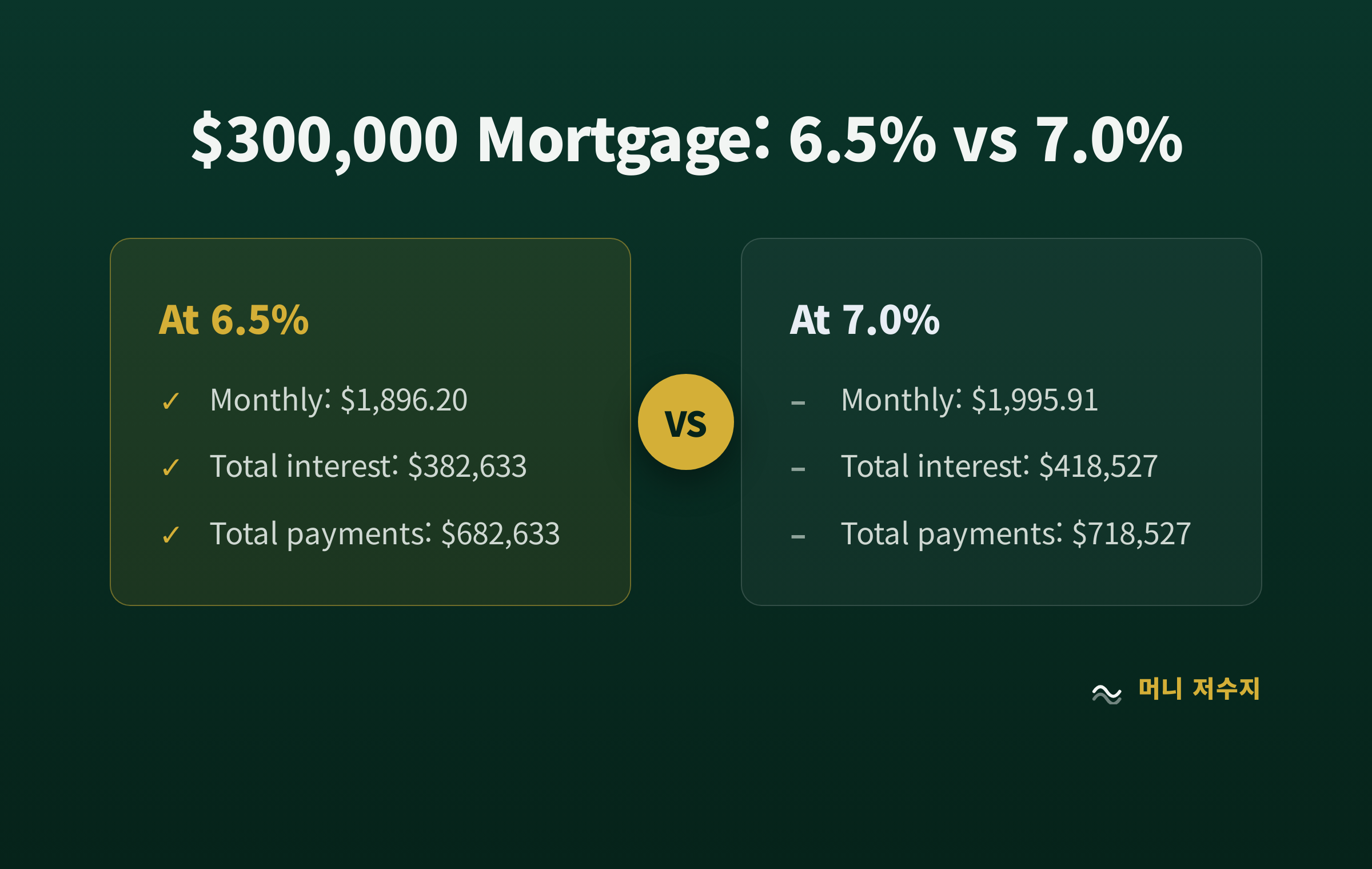
Consider a hypothetical $300,000, 30-year fixed-rate mortgage. Assume the loan is fully amortizing, the interest rate stays fixed, and the borrower makes all scheduled payments.
Here is the estimated difference between two interest rates:
| Mortgage detail | At 6.5% | At 7.0% |
|---|---|---|
| Loan amount | $300,000 | $300,000 |
| Loan term | 30 years | 30 years |
| Monthly principal and interest | $1,896.20 | $1,995.91 |
| Total scheduled payments | $682,633.47 | $718,526.69 |
| Total interest over the full term | $382,633.47 | $418,526.69 |
Estimated difference:
- Monthly principal and interest: approximately $99.70 more at the higher rate.
- Total interest over the full term: approximately $35,893 more at the higher rate.
These figures are calculated from standard fixed-rate mortgage amortization formulas and rounded to cents. They exclude property taxes, homeowners insurance, mortgage insurance, closing costs, and any additional payments. Actual lender offers can differ.
The lesson is not that every borrower should pay any amount necessary to obtain the lowest advertised rate. It is that a rate difference deserves a careful dollar comparison.
If you sell the property after a few years, your actual savings will differ from the full-term calculation. You must also account for any upfront fees required to obtain the lower rate.
4. Three Concrete Steps to Get a Better Mortgage Rate
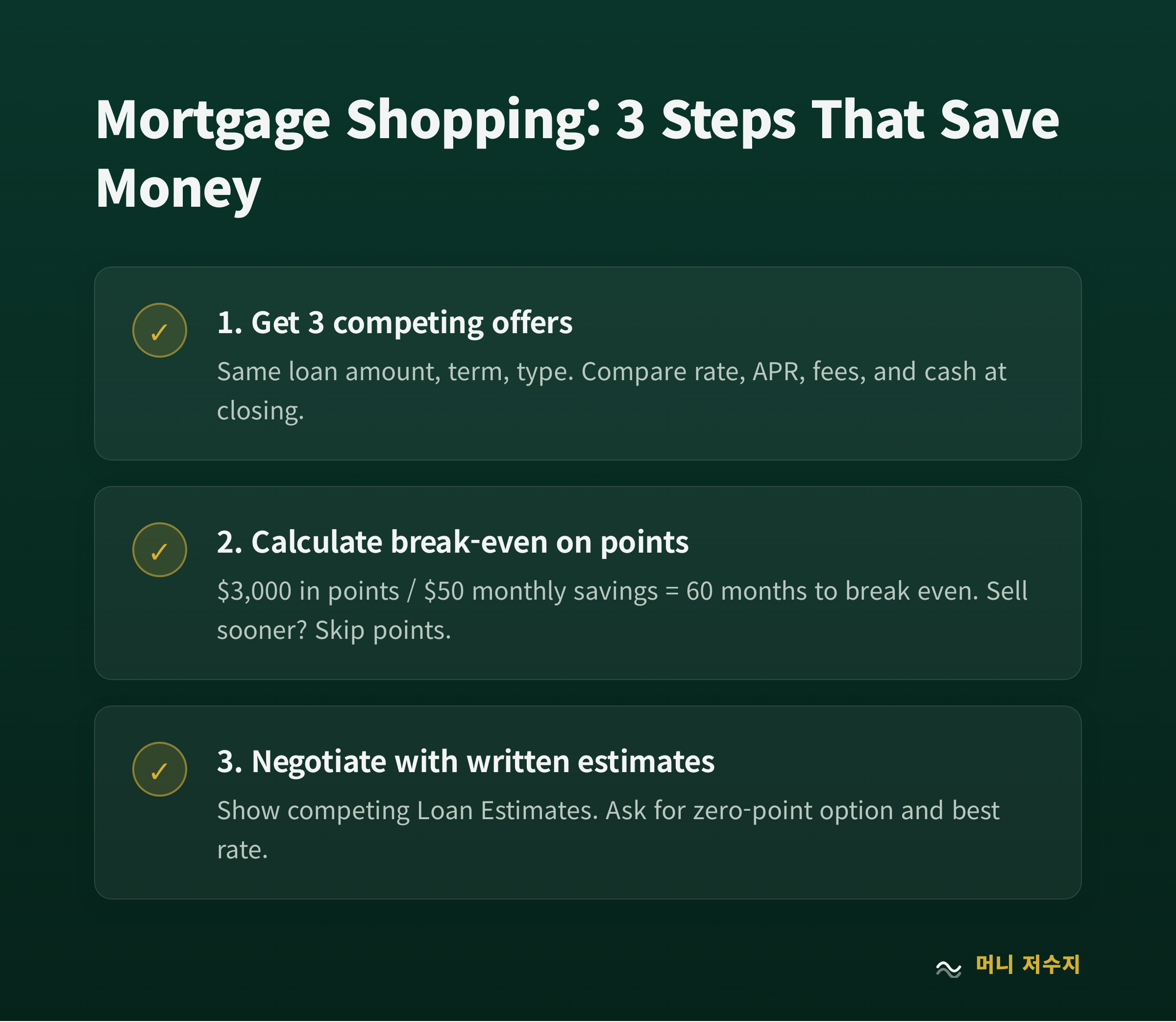
Step 1: Get at least three competing offers
Do not rely on the first bank that approves you or the lender with the most attractive advertisement.
The CFPB recommends comparing offers from at least three lenders. You can contact banks, credit unions, mortgage companies, and lenders that specialize in particular borrower groups or loan programs.
Ask each lender to quote the same scenario:
- Identical loan amount.
- Identical loan term.
- Identical loan type.
- Identical down payment.
- The same occupancy and property assumptions.
- The same discount-point arrangement, preferably including a zero-point option.
Try to obtain the quotes within a short period. Mortgage pricing changes with market conditions, so offers issued on different days may reflect different rates.
When you receive the estimates, compare the interest rate, APR, fees, monthly payment, and cash needed at closing.
Three offers do not guarantee the lowest possible rate, but they give you a much stronger negotiating position than a single quote.
Source: https://www.consumerfinance.gov/consumer-tools/mortgages/shopping-for-a-mortgage/
Step 2: Calculate the break-even point before paying discount points
Imagine a lender offers you two options on a $300,000 mortgage:
- Option A requires $3,000 in discount points.
- Option B has no discount points but carries a higher monthly payment.
For illustration, assume Option A saves you $50 per month in principal and interest compared with Option B.
The simple break-even calculation is:
$3,000 ÷ $50 = 60 months.
In this hypothetical example, it takes 60 months, or five years, for the monthly savings to equal the upfront points cost.
If you expect to sell or refinance substantially earlier, the points may not pay for themselves. If you keep the loan longer, the lower payment may eventually make the upfront expense worthwhile.
This calculation is a starting point, not a complete comparison. A more precise analysis should account for the outstanding loan balance, the timing of payments, and the time value of money. The actual break-even period depends on the rate reduction and fees offered by the lender.
Ask the lender for written estimates with and without points. Do not accept a vague claim that paying points will "save thousands" without seeing the numbers.
Step 3: Negotiate using written Loan Estimates
Once you have competing offers, return to your preferred lender and ask whether it can match or improve the best comparable offer.
For example, you might say:
"I have another Loan Estimate for the same loan amount and term with a lower interest rate and fewer upfront lender charges. Can you review your pricing and provide your best offer with zero discount points?"
This approach gives the lender specific terms to evaluate.
However, do not focus exclusively on the interest rate. A lender might reduce the rate while increasing points, or offer a credit that reduces closing costs in exchange for a higher rate.
Compare the complete package before accepting a revised offer.
Also check whether the lender can meet your purchase contract's closing deadline. A marginally cheaper loan may not be worth a serious risk of delaying the transaction.
The CFPB notes that Loan Estimates can be used to negotiate and that lenders may be willing to match or beat competing offers.
Source: https://www.consumerfinance.gov/owning-a-home/compare/compare-loan-estimates/
5. Common Mortgage Rate Comparison Mistakes
Mistake 1: Comparing rates from different dates
Mortgage rates can change daily. A quote from last week may not be directly comparable with an offer issued today.
Ask when each quote was generated, whether the rate is locked, and how long the quoted terms remain available.
Mistake 2: Ignoring points and lender credits
A low interest rate can require substantial upfront payment. A higher rate may come with lender credits that reduce your closing costs.
Neither structure is automatically better. Compare the costs over the period you expect to keep the loan.
Mistake 3: Assuming APR tells the entire story
APR is useful, but it is not a complete measure of your future housing expenses. It does not replace a review of the interest rate, fees, cash due at closing, taxes, insurance, and the loan's adjustment rules.
For adjustable-rate mortgages, review the initial fixed period, adjustment frequency, rate caps, and potential payment changes.
Mistake 4: Focusing on the monthly payment alone
A longer repayment term can produce a lower monthly payment while increasing the total interest paid over the life of the loan.
Likewise, a lender may quote a payment that excludes property taxes, homeowners insurance, or mortgage insurance.
Ask whether the quoted payment is principal and interest only or includes escrow and other recurring costs.
Mistake 5: Treating "no closing costs" as free
A no-closing-cost mortgage may reduce your upfront cash requirement, but the lender may offset those costs through a higher interest rate or another arrangement.
Ask exactly which costs are waived, which are financed, and which are covered through lender credits.
Source: https://www.consumerfinance.gov/owning-a-home/compare/compare-loan-estimates/
Mistake 6: Making a decision before checking the five-year cost
You may not keep the mortgage for its entire term. If you plan to move, sell, or refinance, the full 30-year interest calculation can be less useful than the cost over your expected holding period.
Use the Loan Estimate's five-year comparison and request additional calculations if you expect to keep the loan for a different length of time.
6. Practical Checklist: What to Ask Every Lender
Use this checklist when requesting and comparing mortgage offers.
Rate and loan terms
- What is my quoted interest rate?
- Is the rate fixed or adjustable?
- Is the rate locked? If so, when does the lock expire?
- What loan program and term does this offer use?
- Does this quote assume a specific credit score or down payment?
Upfront expenses
- How many discount points are included?
- What is the dollar cost of those points?
- What are the lender's origination charges?
- Are lender credits included?
- Which closing costs are excluded from the estimate?
Monthly and long-term costs
- What is the monthly principal-and-interest payment?
- What will the estimated total monthly housing payment be, including taxes and insurance?
- What is the APR?
- What is the estimated five-year cost of borrowing?
- How much principal will I have repaid after five years?
- What happens if I refinance or sell earlier than expected?
Loan conditions
- Is mortgage insurance required?
- Are there prepayment penalties?
- Are there rate-adjustment caps if the loan is an ARM?
- Can the lender meet my expected closing date?
- What could cause the final terms to change?
Negotiation
- Can you provide an option with zero discount points?
- Can you provide another option with points so I can compare the break-even period?
- Can you match a competing written offer?
- Will reducing one fee increase another charge?
Request written answers wherever possible. If an answer is unclear or differs from the Loan Estimate, ask the lender to explain the discrepancy before proceeding.
Conclusion: Compare the Cost, Not the Advertisement
The best mortgage offer is not necessarily the one with the lowest number in a headline. It is the offer that fits your finances, your plans for the property, and the amount of cash you can comfortably bring to closing.
Start by requesting comparable quotes from multiple lenders. Review the interest rate and APR, identify any discount points or lender credits, and compare the five-year cost of borrowing. Then use competing Loan Estimates to negotiate.
Before paying for points, calculate how long it will take for the monthly savings to recover the upfront expense. Before choosing a lower monthly payment, check whether the loan term or adjustable-rate structure changes the long-term risk.
Finally, remember that mortgage quotes are snapshots of a changing market. A national average helps establish context, but your own written offers determine what is actually available to you.
Your next steps: Gather competing Loan Estimates, normalize the terms, calculate the break-even point for any upfront fees, and choose the offer that makes the most financial sense for your expected time in the home.
Sources and Further Reading
- Freddie Mac — Primary Mortgage Market Survey: https://www.freddiemac.com/pmms
- CFPB — Shopping for a Mortgage: https://www.consumerfinance.gov/consumer-tools/mortgages/shopping-for-a-mortgage/
- CFPB — Compare Loan Estimates: https://www.consumerfinance.gov/owning-a-home/compare/compare-loan-estimates/
- CFPB — Mortgage Rate Explorer: https://www.consumerfinance.gov/owning-a-home/explore-rates/
- CFPB — Discount Points and Lender Credits: https://www.consumerfinance.gov/ask-cfpb/how-should-i-use-lender-credits-and-points-also-called-discount-points-en-136/
- AnnualCreditReport.com — Official Credit Report Access: https://www.annualcreditreport.com/
- U.S. Department of Veterans Affairs — Home Loans: https://www.va.gov/housing-assistance/home-loans/
- U.S. Department of Housing and Urban Development — FHA Loans: https://www.hud.gov/helping-americans/fha-loans
This article is for general educational purposes and is not individualized financial, tax, or legal advice. Mortgage terms, rates, fees, and eligibility vary by borrower and lender. Confirm all terms in your written Loan Estimate before making a decision.
Comments
Post a Comment