ACA Open Enrollment for 2027: Check Your Deadline, Subsidy, and Total Health Insurance Costs
By Daniel Kim

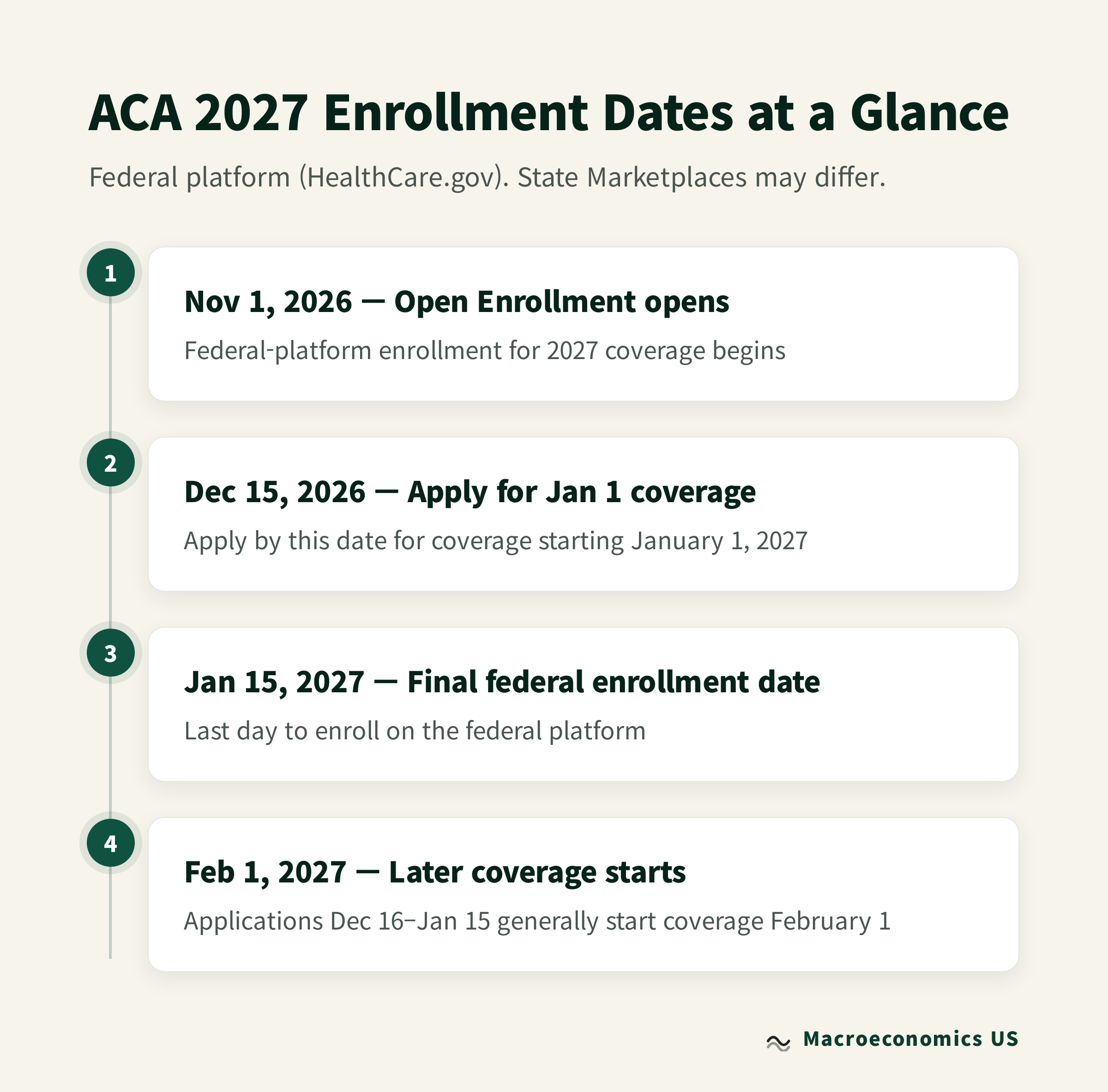
December 15, 2026 is the deadline to apply on the federal platform for coverage that starts January 1, 2027, but it is not the final federal enrollment date, which is January 15, 2027. Picture a hypothetical shopper (not a real person) who read that December 15 is the last day to enroll and worries the window has closed: on the federal platform, applications from December 16 through January 15 generally start coverage February 1. A state Marketplace could run on a different calendar, so the date that counts for you is the one your own Marketplace publishes.
This guide answers two questions: which date applies to your Marketplace, and what to verify before you choose a plan. It is general information for U.S. residents buying individual Marketplace coverage without employer-sponsored insurance, not tax, legal, or insurance advice. Facts are as of October 15, 2026.
Know Your Actual Deadline

As of October 15, 2026, federal-platform Open Enrollment for 2027 runs from November 1, 2026 through January 15, 2027. The background: CMS-9884-F originally shortened the federal-platform period to December 15, a June 2026 Maryland federal court vacated that shortening provision, and CMS stated in August that it would operate the federal platform from November 1 through January 15 regardless of the appeal.
Keep two federal dates apart: December 15 is the cutoff to apply for January 1 coverage, and January 15 is the final enrollment date. My read: because a court ruling and an appeal are involved, treat December 15 as the safest target date if you want January 1 coverage. Check HealthCare.gov Dates and deadlines and your own Marketplace's official calendar rather than relying on an older guide, including this one.
| Question | Federal platform (HealthCare.gov) | California (Covered California) | New York (NY State of Health) |
|---|---|---|---|
| When does enrollment open? | November 1, 2026 | November 1, 2026 | November 1, 2026, per its homepage |
| What is the final enrollment date? | January 15, 2027 | January 31, 2027 | Not verified here; check NY State of Health |
| When does coverage begin? | January 1, 2027 if you apply by December 15, 2026; generally February 1, 2027 if you apply December 16, 2026 through January 15, 2027 | December 31, 2026 is the deadline for coverage throughout 2027; for later sign-ups, confirm the start date with Covered California | Not verified here; check NY State of Health |
| What if the deadline is missed? | Check Special Enrollment Period eligibility based on a qualifying life event, and see the Medicaid and CHIP note below. | ||
If you miss Open Enrollment, check whether you qualify for a Special Enrollment Period based on a qualifying life event. Missing the window does not automatically create eligibility. Qualifying events include losing qualifying health coverage, moving, getting married, or having a baby, and HealthCare.gov generally describes a 60-day window before or after certain events, though the precise window depends on the event (HealthCare.gov Coverage outside Open Enrollment). Medicaid and CHIP applications can be made year-round, and eligibility varies by state and circumstances. Eligible children may qualify for CHIP even when household income is too high for Medicaid (HealthCare.gov Medicaid and CHIP). Neither program is guaranteed, and a missed deadline does not by itself mean you stay uninsured.
Premium, Premium Tax Credit, and APTC in Plain English
Your premium is the monthly price of the plan. The Premium Tax Credit (PTC) is a federal tax credit that can lower the cost of Marketplace coverage if you meet IRS requirements. The Advance Premium Tax Credit (APTC) is that credit paid in advance, estimated from the projected household income and household information you report.
IRS general guidance describes the ordinary income range as household income between 100% and 400% of the federal poverty line, subject to additional requirements such as Marketplace enrollment, tax-filing requirements, and no disqualifying eligibility for qualifying employer-sponsored or government coverage. Household income alone does not establish eligibility (IRS Premium Tax Credit overview). The temporary removal of the 400% upper limit applied to tax years 2021 through 2025, and later legislation changed the rules, so do not assume the enhanced subsidy structure continues for 2027. A proposed extension or pending bill is a proposal, not current law. This guide lists no 2027 dollar-income table because those thresholds are unverified.
Update the Marketplace promptly when your income, household size, address, or eligibility for other coverage changes. Advance credits are reconciled on your federal tax return using Form 8962 (IRS Claiming and reconciling advance payments).
Repayment caps are eliminated starting with tax year 2026
The IRS states that legislation removed the repayment limitation for excess advance Premium Tax Credit payments beginning with tax year 2026. For tax year 2026 and later applicable years, you repay the full amount by which your advance payments exceed your allowable Premium Tax Credit, rather than relying on previous income-based caps (IRS Repayment caps eliminated).
Chain for 2027 coverage: tax year 2026, cap removed → 2027, advance credit estimated from your projected income and household → tax year 2027, credit reconciled on Form 8962 against your actual circumstances → any excess repaid in full. The dollar amount depends on your own numbers, so this guide quotes none. Older articles that treat repayment as always capped do not reflect this change.
Reader math (plug in your own numbers):
- Percent math: income as a percent of the poverty line = household income ÷ the applicable poverty guideline for your household size × 100.
- Dollar math: dollar amount = the applicable poverty guideline × the percentage you are testing; confirm the guideline in current Marketplace instructions.
- Repayment math: excess advance credit = advance credit paid for you during the year minus the Premium Tax Credit you are allowed based on your actual income and household. A positive result is repaid in full.
Compare Total Cost, Not Just the Premium
As of October 15, 2026, HealthCare.gov Health plan categories lists these average cost splits. They estimate how covered costs are shared across a standard population, not what your insurer pays on any individual bill.
| Metal tier | Plan pays (average) | You pay (average) | Compare first |
|---|---|---|---|
| Bronze | 60% | 40% | Deductible and out-of-pocket maximum |
| Silver | 70% | 30% | Cost-sharing reduction eligibility (qualifying Silver plan required) |
| Gold | 80% | 20% | Premium after any credit versus copays and coinsurance |
| Platinum | 90% | 10% | Premium after any credit versus network and drug list |
| Caveat: actual payments depend on plan terms, covered services, deductibles, copayments, coinsurance, and network status. | |||
Percent math describes a group, much as a class average describes a class and not your own score. Dollar math lives in each plan's documents: premium, deductible, copayments, coinsurance, and out-of-pocket maximum.
Premium tax credits and cost-sharing reductions are separate tools. A Premium Tax Credit can apply across eligible metal categories, while cost-sharing reductions require a qualifying Silver plan and can improve cost-sharing for eligible consumers. HealthCare.gov lists enhanced Silver cost-sharing estimates separately, so the Silver row above does not include them (HealthCare.gov Cost-sharing reductions).
My read (rule-of-thumb, not a forecast): a side-by-side yearly figure for each plan = (monthly premium after any advance credit × months covered) + out-of-pocket maximum. Run it for each plan you are considering, then compare deductibles, copays, and coinsurance.
Verify Doctors, Hospitals, and Prescriptions

An insurer's brand name does not establish that a particular provider participates in a specific plan's network. Provider directories and drug lists can change or contain errors, so confirm with both the insurer and the provider; even then, coverage is not guaranteed (background: HealthCare.gov Plan types and networks). Before you choose a plan, check:
- Exact doctor and exact plan: confirm the physician participates in that specific plan, not just with that insurer.
- Hospitals and specialists: confirm your hospital is in the plan's network, and check referral requirements and whether your specialists participate.
- Each important prescription: find it in the plan's formulary and note its tier, deductible treatment, copay or coinsurance, and restrictions.
- Pharmacy participation: confirm your pharmacy is in the plan's pharmacy network.
- Deductibles and copays: see how each applies to the care and drugs you use now.
- Anything uncertain: ask the insurer to confirm it before you enroll.
Automatic Renewal Is Not a Substitute for Review
Automatic re-enrollment can keep an existing Marketplace enrollee covered for next year without selecting a plan again. You could be matched to the same plan, a different plan from the same insurer, or an alternative if your plan is discontinued. Existing enrollees should receive a Marketplace letter and an insurer letter by November 1 describing the renewal match, premium, plan availability, and any action needed to confirm eligibility (HealthCare.gov Automatic re-enrollment).
Renewal does not guarantee the same premium, the same network or prescription coverage, or that your original plan stays available, and you still need to update projected income and household information. Before accepting a renewal, review:
- The new premium and whether your plan is still available
- Whether your doctors and prescriptions are still covered
- Your projected household income and household information
- Eligibility notices and documentation requests
- The deadline for changing plans in your Marketplace
HealthCare.gov states that the first premium needs to be paid for coverage to start, and your insurer provides payment instructions. Being enrolled through the Marketplace is not, by itself, proof that coverage is in effect.
A 2025 CMS rule set a $5 monthly premium requirement for certain automatically re-enrolled zero-premium federal-platform enrollees who had not confirmed or updated eligibility information; CMS stated it would sunset at the end of plan year 2026, so this guide does not apply it to 2027. Check for any later rule with your Marketplace (CMS 2025 Marketplace Integrity and Affordability Final Rule).
State Marketplaces Can Run on Different Calendars
State-based Exchanges can operate on different schedules within applicable federal rules, so the federal dates above are not a national schedule. As of its August 25, 2026 announcement, Covered California runs enrollment from November 1, 2026 through January 31, 2027, with December 31, 2026 as the deadline for coverage throughout 2027. Those dates differ from the federal-platform schedule (Covered California 2027 announcement).
As of October 15, 2026, the NY State of Health homepage says enrollment opens November 1, 2026; this guide states no closing date because it is unverified, and it lists no dates for other states. To find your state's official Marketplace and its enrollment calendar, start at HealthCare.gov Marketplace in your state.
Final Checklist Before You Enroll
Save this block:
- Identify the right Marketplace for your state (federal platform or state-based Exchange).
- Verify your applicable deadline (federal platform: December 15 for January 1 coverage, January 15 final; California: December 31 for coverage throughout 2027, January 31 final; other states: read the official calendar).
- Estimate household income for the coverage year, and update the Marketplace when income, household size, or address changes.
- Review Premium Tax Credit and eligibility notices, remembering that excess advance credit is repaid in full from tax year 2026.
- Compare premiums, deductibles, copays, coinsurance, and out-of-pocket maximums for each plan.
- Check doctors, hospitals, prescriptions, and pharmacies against the exact plan.
- Review any automatically selected renewal plan instead of assuming it is unchanged.
- Complete enrollment and confirm first-premium payment requirements with your insurer.
- Save your confirmation and plan documents.
Next action: open HealthCare.gov Marketplace in your state and confirm which calendar applies to you. Find your Marketplace first, then your date, then your plan.
About the author: Daniel Kim
Daniel Kim writes about practical knowledge for everyday life and your wallet — from household money decisions to understanding the economy around you.
Comments
Post a Comment