What Happens When the Fed Cuts Interest Rates: The Credit Card Path
Contents
- Side-by-side comparison
- What actually moves the 10-year yield
- Why the 10-year is near 5.3% right now
- Answering the objections
- FAQ
- Bottom line
After the Federal Reserve’s September 16 hike, its target range stands at 3.75–4.00%. Yet on October 1, the 10-year Treasury yield touched 5.34% — its highest since 2002, according to Reuters. The Fed spent most of 2026 cutting its policy rate; through it all, the 10-year kept climbing. That split is the whole story. When the Fed cuts rates, the immediate impact is not uniform across all credit products. Your savings account interest drops within days. Credit card APRs and HELOCs, tied to the prime rate, adjust quickly. However, your mortgage rate often remains high.
This disconnect confuses many borrowers. Mortgage rates follow the ten-year Treasury yield, not the federal funds rate directly. If long-term inflation expectations stay elevated, mortgage rates resist cuts. You might see your credit card bill decrease while your home loan payment stays the same.
This piece explains the transmission mechanism from the Fed to your wallet. It details which debts shrink first and why mortgages lag. You will learn how to verify current rates directly on FRED. No financial product recommendations are made here. If you sign up for any financial service mentioned in related contexts, we may receive compensation. Focus on the structural links between short-term policy rates and long-term market yields.
When the Federal Reserve cuts the federal funds rate, the immediate impact is on short-term borrowing costs. This change does not automatically lower every interest rate you see. It primarily affects variable-rate products like credit cards, home equity lines of credit, and savings accounts. Mortgage rates, however, respond to a different market signal: the 10-year Treasury yield. This distinction explains why you might see lower credit card rates while your mortgage rate stays high.
The mechanism works through a chain of financial links. The federal funds rate is the cost for banks to borrow from each other overnight. When the Fed lowers this target, banks' cost of funding drops. They then adjust the prime rate, which is typically the federal funds rate plus a fixed margin. Since most variable-rate consumer debt is tied to prime, your credit card minimum payments or HELOC interest charges decrease. Conversely, savings account yields often fall because banks have less incentive to pay you to hold cash when they can lend it out cheaply.
Mortgages follow the 10-year Treasury yield because mortgage-backed securities trade against these government bonds. If investors expect long-term inflation to remain elevated, they demand higher yields on 10-year Treasuries, keeping 30-year mortgage rates sticky even after short-term rate cuts. You can verify current mortgage rates by checking recent loan estimates from major lenders, as these rates fluctuate daily based on bond market movements rather than Fed announcements.
This dynamic creates a specific financial reality for you. You may save money on revolving credit and variable loans immediately after a cut. However, if you are planning to buy a home, you cannot expect your mortgage rate to drop in sync with the Fed’s action. Check your credit card statements and savings account APYs after each Fed meeting to see the direct effects of these short-term rate shifts on your personal finances.
Side-by-side comparison
The mechanism of rate cuts does not affect all debt equally. While short-term borrowing costs adjust quickly, long-term rates like mortgages move on a different timeline. This creates a gap between the Federal Reserve’s policy actions and your monthly payment for a home. Understanding this distinction prevents confusion when the news announces a cut but your mortgage rate remains static.
Data source: FRED (Federal Reserve Economic Data)
| Metric | The Case For (Immediate Impact) | The Case Against (Lagging Impact) |
|---|---|---|
| Primary Driver | Federal Funds Effective Rate | 10-Year Treasury Yield |
| Current Value | 3.75–4.00% target range (after the Sep 16, 2026 hike) | 7.03 Percent (30-Year Fixed Mortgage Average, as of 2026-09-24) |
| Affected Products | Credit cards, HELOCs, variable-rate savings | 30-year fixed-rate mortgages |
| Time to Adjustment | Days to weeks after FOMC decision | Months to years, depending on long-term inflation expectations |
| Direct Consumer Impact | Lower interest on revolving debt; higher yield on money market accounts | No immediate change in payment for existing fixed-rate loans |
| Verification Method | Check bank statements for interest accrual changes | Monitor Freddie Mac’s weekly survey (as of 2026-09-25) for average rates |
| Contextual Benchmark | CPI Index: 334.131 (as of 2026-08-01) | Same CPI Index applies to long-term inflation expectations |
The Federal Funds Effective Rate stood at 3.88 percent as of September 28, 2026, according to FRED data (series DFF). This rate acts as the baseline for prime rates, which banks use to price credit cards and home equity lines of credit. When the Federal Reserve lowers this target, banks typically reduce their prime rates within days. This directly lowers the interest you pay on credit card balances and the draw period interest on a HELOC. Conversely, if you hold savings in variable-rate money market funds, the interest you earn will fall as the fed funds rate falls, incentivizing banks to pay you more to hold your cash.
Mortgages do not follow this path. The 30-year fixed-rate mortgage average was 7.03 percent as of September 24, 2026, per FRED (series MORTGAGE30US). This rate tracks the 10-year U.S. Treasury yield, not the federal funds rate. Treasuries reflect what investors expect inflation to be over the next decade. If the Federal Reserve cuts rates but investors believe inflation will remain stubbornly high, the 10-year yield may not drop, or may even rise. This explains the paradox where the Fed cuts rates, but mortgage rates stay near 7 percent. Your wallet feels the cut immediately on credit card interest, but not on your mortgage payment unless long-term inflation expectations shift. To verify current mortgage rates, check the latest weekly survey from Freddie Mac, as assigned evidence is dated September 2026.
What actually moves the 10-year yield
Here is the part most explainers skip: the 10-year yield is not set by the Fed. It is set by investors bidding on 10-year bonds, and they demand compensation for three things.
1. Growth expectations. When the economy looks strong, investors expect better returns elsewhere, so they demand a higher yield to lock money up for a decade.
2. Inflation expectations. If prices are expected to rise 3% a year, a bond paying 3% loses purchasing power. Investors price that in upfront.
3. Supply and the fear premium. When the government floods the market with new bonds to fund deficits — or when investors simply want extra compensation for uncertainty — yields rise to attract buyers.
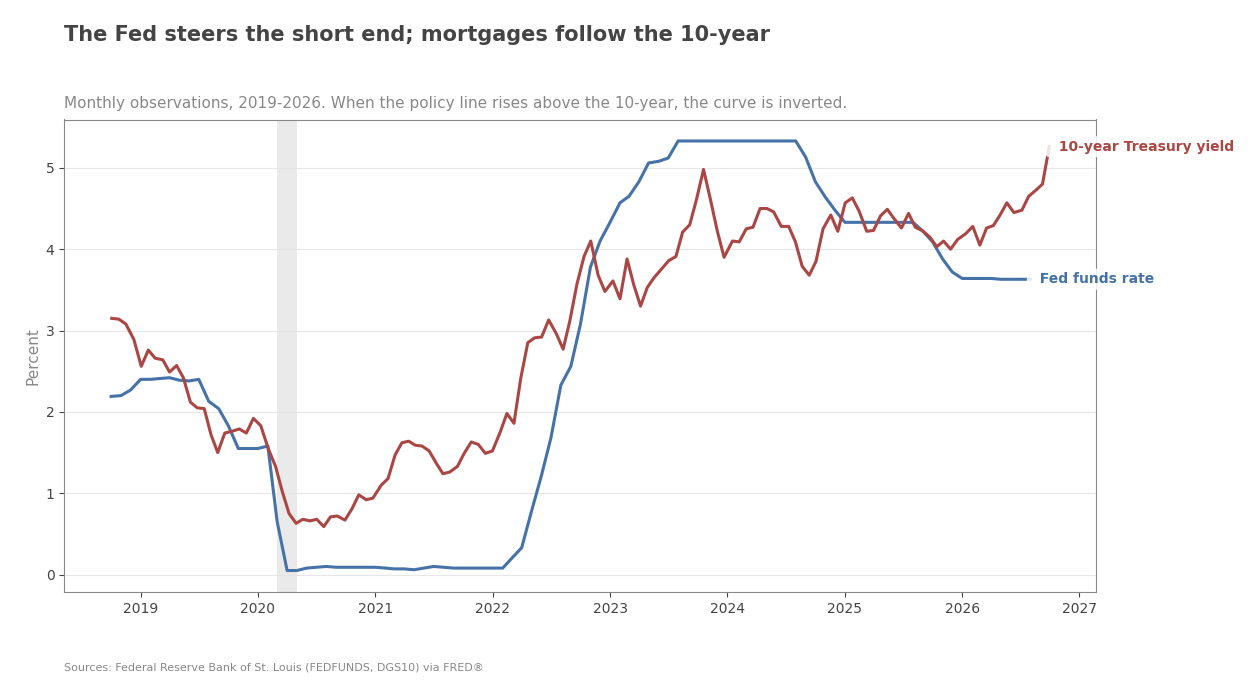
Think of it this way: the Fed controls the price of overnight money. The 10-year is a rolling 10-year forecast, voted on every second by the bond market. The chart above shows what happens when the forecast disagrees with the Fed: in 2026 the policy rate fell while the 10-year rose.
Why the 10-year is near 5.3% right now
On October 1, 2026, the 10-year Treasury yield touched 5.34% — its highest since early 2002, surpassing even the 2007 peak, according to Reuters. It just posted its biggest quarterly jump this century. Three forces are pushing it there:
The Fed is still hiking, not cutting. The September 16 hike took the target range to 3.75–4.00%, and New York Fed president John Williams — considered a dove — said on September 29 that another hike later this year "may be appropriate."
A flood of new bonds. The Treasury is rolling over a massive deficit with new debt, while hyperscalers are issuing corporate bonds to fund AI infrastructure. Morgan Stanley forecasts AI-related corporate bond issuance will more than double this year to $570 billion.
Sticky inflation pressure. August PCE inflation came in at 3.4% (core 3.0%), still well above the Fed's 2% target, and oil is hovering near $100 a barrel as U.S.–Iran talks stall.
Notice the key detail: the 10-year now sits above the Fed's policy rate. The bond market is saying inflation will stay sticky even as the Fed tightens — which is exactly why mortgage rates refuse to fall.
Answering the objections
"I think if the Fed cuts, my mortgage rate drops right away."
You make a fair point. It feels logical that lower policy rates should immediately lower the cost of borrowing for everyone, including homeowners. If you are watching the news, you expect immediate relief for your monthly payments.
However, that connection is broken. Mortgage rates do not track the federal funds rate. They follow the 10-year Treasury yield. When the Federal Reserve adjusts its target, it influences short-term borrowing costs, not long-term fixed rates directly.
The mechanism creates a paradox. You can see the Federal Funds Effective Rate at 3.88 percent as of September 28, 2026, according to FRED data. Yet, your mortgage rate depends on what bond traders expect for inflation and economic growth over the next decade. If those expectations remain high, the 10-year yield stays elevated.
Consequently, a Fed cut might leave your mortgage rate flat or even push it higher if bond yields spike. Do not rely on headlines about policy cuts to predict your payment. Check the MORTGAGE30US index directly to see the actual market rate for 30-year fixed mortgages. This distinction determines whether a policy change saves you money or leaves your budget unchanged.
FAQ
Will a Fed decision change your current car payment?
If you have a fixed-rate auto loan, a Federal Reserve rate cut will not alter your monthly payment until the loan is fully paid off. Your contract locks in the interest rate for the term of the loan. However, if you hold a variable-rate loan, your payment may decrease once the bank passes the lower prime rate into your contract. Check your loan agreement for the specific lag period, which often ranges from 30 to 90 days, before you expect any change in your bill. You can verify your current rate type by logging into your lender’s online portal or calling their customer service line directly.
Does a Fed rate hike mean car loan rates will rise?
Yes, but not immediately. Car loan rates are tied to the prime rate, which tracks the federal funds rate. When the Fed hikes rates, the prime rate typically rises within a few days. Lenders then adjust their new loan offers, often within a week or two. If you are shopping for a car now, check the current prime rate on the Federal Reserve’s website to estimate the baseline cost. Your specific rate depends on your credit score and the loan term, so a hike raises the floor for all new contracts.
The Fed is talking about cuts. Why are mortgage rates still high?
Mortgage rates do not follow the federal funds rate; they follow the 10-year U.S. Treasury yield. This long-term bond reflects market expectations for inflation and economic growth over a decade. Even if the Fed cuts short-term rates, investors may still demand higher yields for long-term risk. To see this dynamic, compare the current 10-year Treasury yield with the 2-year Treasury yield on the U.S. Department of the Treasury’s website. If the 10-year yield remains stubbornly high, mortgage rates will stay elevated regardless of Fed cuts.
How should I position my 401(k) based on Fed rate expectations?
Do not time your 401(k) allocation based on Federal Reserve meetings. Your portfolio should reflect your age, risk tolerance, and retirement horizon, not short-term rate fluctuations. If you are nearing retirement, a balanced mix of bonds and stocks provides stability. If you are younger, a higher equity allocation captures long-term growth. Consult a fee-only financial planner to review your current allocation. They can assess whether your mix aligns with your specific goals without relying on speculative rate predictions.
What happens to short-duration bond ETFs if the Fed cuts rates?
Short-duration bond ETFs typically gain in price when the Fed cuts rates. As yields fall, existing bonds with higher coupon rates become more valuable. These funds hold bonds that mature in one to three years, so they are sensitive to rate changes. You can track the yield-to-maturity of these funds on their official fund websites. If you hold these ETFs, a rate cut can provide positive capital appreciation in addition to your regular income. Verify the fund’s average duration to understand its exact sensitivity to rate movements.
Is SGOV a good alternative to a savings account?
SGOV is a Treasury bill ETF that offers yields close to short-term government rates. It is not FDIC insured like a savings account, so it carries slight market risk. However, it is often tax-advantaged at the state and local level. Compare the current 7-day SEC yield of SGOV on its fund page with the annual percentage yield (APY) of your bank’s high-yield savings account. If the ETF’s yield is higher after accounting for any state taxes you would otherwise pay on savings interest, it may be a more efficient holder for cash reserves.
How do changes in the Federal Funds Rate impact your loans?
The Federal Funds Rate serves as the base for most variable-rate consumer debt. When the Fed cuts rates, the prime rate drops, and your credit card or HELOC rates may follow. However, banks have discretion in how quickly they pass these cuts to you. Review your credit card agreement for the specific indexing method. If your rate is tied to the prime rate, expect a decrease within one to two billing cycles after a Fed cut. Call your issuer to confirm the exact date of any rate adjustment.
Why Can Treasury Yields Rise Even When the Fed Cuts Rates?
Yields can rise if investors expect inflation to stay high or if the economy grows faster than anticipated. The Fed controls short-term rates, but the bond market sets long-term rates based on risk and demand. If investors fear that rate cuts are too aggressive, they may sell bonds, driving prices down and yields up. Monitor inflation data releases from the Bureau of Labor Statistics. A stronger-than-expected inflation report can cause yields to spike immediately, overriding the impact of recent Fed cuts on the market.
What happens to bonds when the Fed raises rates?
When the Fed raises rates, existing bond prices fall because new bonds offer higher interest rates. This inverse relationship is standard for fixed-income investments. If you hold long-term bonds, you may see a significant drop in their market value. However, if you hold them to maturity, you will receive the full face value. Check the duration of your bond holdings to estimate their price sensitivity. For short-term bonds, the price impact is smaller, making them more resilient to rate hikes.
Bottom line
So when will your mortgage rate come down? Watch the 10-year, not the Fed's press conferences. Mortgage rates fall when the 10-year yield falls — and the 10-year falls when one of three things happens: inflation convincingly cools toward 2%, the Fed's path turns clearly toward cuts, or investors rush into safe bonds.
Your practical watchlist is short: the 10-year yield itself (FRED series DGS10, updated daily), the monthly PCE inflation prints, and the Fed's meeting calendar. No one can time the turn. But now you know which domino has to fall first. It was never the announcement from the podium. It is the bond market's verdict — and it is published every single day.
Disclosure: This article is for informational purposes only and is not financial advice. Consider consulting a licensed financial professional for advice tailored to your situation.